
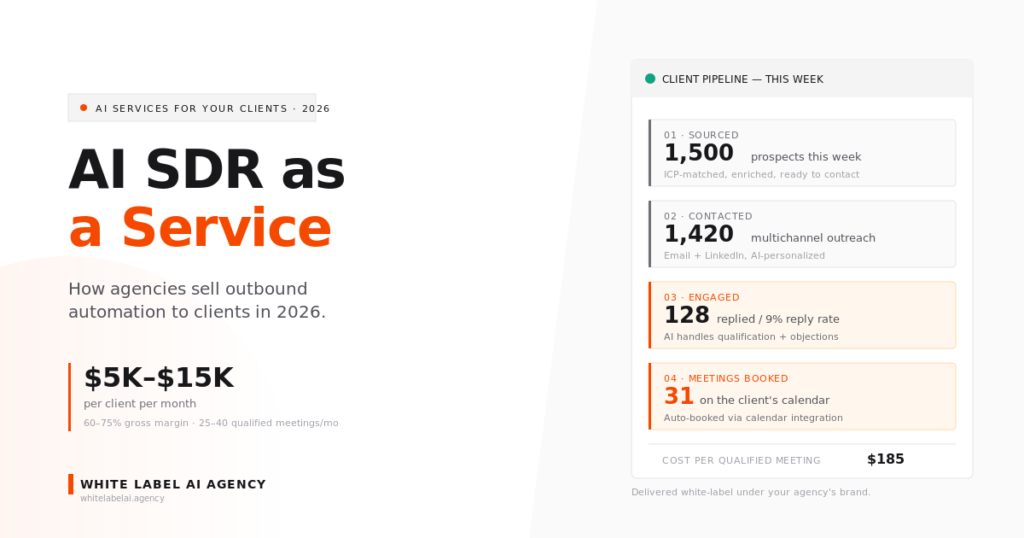
White label AI SDR services let agencies sell outbound automation to clients without hiring an SDR team. Agencies productize prospecting, enrichment, multichannel outreach, and meeting booking, charge clients $5,000 to $15,000 per month, and deliver it through a white-label partner. The AI SDR market hit $5.22B in 2026 and is the highest-margin AI service category for agencies right now.
Why AI SDR is the highest-margin AI service category for agencies in 2026
The AI SDR market grew from $4.27 billion in 2025 to $5.22 billion in 2026 and is projected to hit $24.32 billion by 2034, a 21.2% CAGR according to Fortune Business Insights. Other research firms put the 2026 figure even higher with 32.3% CAGR (The Business Research Company). Whichever model is right, the direction is the same: the SDR function is being rebuilt around AI faster than any other sales role, and the buyers paying for it are agencies’ clients.
The economics are why this is the hottest category for agencies right now. Traditional outsourced SDR services cost the agency’s client $2,500 to $8,000 per dedicated rep per month, with 20 to 30 qualified meetings as the benchmark output (Outbound Sales Pro 2026 survey). White-label AI SDR delivery costs the agency $700 to $3,000 per client per month, produces comparable or better meeting volume, and can be priced at $5,000 to $15,000 per client per month. That’s 60 to 75% gross margin on a service category the client is already budgeting for.
The Growth Agency testimonial on our homepage captures the model: “We’ve doubled client outreach volume with AI personalization and automations, without adding more SDRs.” That agency isn’t running AI SDR for itself. It’s running it on behalf of its clients, under its brand, with the technical execution handled white-label. Same model, different applications, repeatable across the agency’s entire book of business.
What “AI SDR as a service” actually means
AI SDR as a service is a productized agency offering that delivers prospecting, lead enrichment, multichannel outreach (email, LinkedIn, phone where applicable), reply handling, meeting booking, and weekly performance reporting on behalf of the agency’s clients. The agency owns strategy, ICP definition, and the client relationship. A white-label partner runs the AI tooling and the day-to-day execution.
This is a different category from “we’ll set up Smartlead for your client.” That’s tooling resale. AI SDR as a service means the agency is responsible for the outcome: meetings booked per month, response rate, pipeline contribution, cost per meeting. Those numbers go into the monthly client report and become the basis for renewal.
The deliverable the client sees:
- A weekly pipeline report (prospects sourced, contacted, engaged, meetings booked)
- Meetings landing on their sales team’s calendar
- A monthly performance review with their account manager
- A named ICP definition document and message library that they own
What the client never sees:
- The white-label partner running the tooling stack (named platforms covered in the comparison section below)
- The model-tuning, message-iteration, and deliverability work happening in the background
- The integration layer between the partner’s stack and the client’s CRM
That separation is what makes the margin work.
The 5 components of a productized AI SDR offering
Every AI SDR service engagement should ship with these five components. Less and you’re selling a tool. More and the scope creeps until the margin disappears.
1. ICP definition and prospect sourcing. The first deliverable is a named ICP document with firmographic, technographic, and behavioral signals. Sourcing happens via Apollo, ZoomInfo, Clay, or similar. Most engagements run 1,000 to 5,000 sourced prospects per month per ICP for the agency’s client.
2. AI-powered enrichment and personalization. Each prospect gets enriched with title, role responsibilities, recent activity, and trigger events. Personalization at the message level uses these signals — the difference between “Hey, saw you’re in marketing” and “Saw your team just hired three SDRs in Q1” is the difference between a 2% reply rate and a 12% reply rate.
3. Multichannel outreach orchestration. Email-first sequences, with LinkedIn for warm signals and phone for high-intent replies. Cadence runs 5 to 9 touches over 14 to 21 days. Tools layer here: Smartlead or Instantly for email infrastructure, AiSDR or CloseBot for AI-powered conversation, native LinkedIn integrations for second-channel touch.
4. Reply handling and meeting booking. AI-handled responses for the predictable categories (objection handling, qualification, calendar negotiation) with human handoff for nuanced replies. Meetings book directly to the client’s sales team’s calendar via Calendly or Chili Piper integration.
5. Weekly and monthly reporting. Pipeline metrics (prospects sourced, contacted, engaged, meetings booked, no-shows, qualified). Cost per qualified meeting. Reply rate trend. Top performing message variants. The report is white-labeled with the agency’s brand.
A good benchmark for a single ICP at scale: 1,500 prospects contacted per month, 4–10% reply rate, 25–40 qualified meetings booked per month. Less than that and the program needs tuning. More than that and you’re probably overspending on volume vs quality.
Pricing tiers: what to charge clients
Pricing benchmarks across the AI SDR services market in 2026:
| Tier | ICPs covered | Monthly volume | Monthly client price | Wholesale delivery cost | Agency margin |
|---|---|---|---|---|---|
| Starter | 1 ICP | 500–1,500 prospects | $3,000–$6,000 | $700–$1,500 | 65–75% |
| Growth | 2–3 ICPs | 2,500–7,500 prospects | $6,000–$12,000 | $1,500–$3,000 | 60–72% |
| Enterprise | Multi-ICP, multi-region | 10,000+ prospects | $12,000–$25,000+ | Custom | 55–65% |
These benchmarks come from agency pricing surveys (Outbound Sales Pro 2026, AiSDR pricing data, ORRJO outsourced SDR cost guide). Specific pricing depends on the client’s vertical and ACV.
A few pricing rules that hold:
Charge a setup fee. $2,500 to $7,500 covers ICP research, message library development, infrastructure setup (mailbox warmup, domain configuration, sequence build), and CRM integration. Skipping this fee teaches the client that the strategic work is free, which kills margin on every renewal.
Don’t price per booked meeting alone. Per-meeting pricing ($200 to $500 per qualified meeting) sounds clean but creates incentive misalignment. The agency benefits from more meetings, the client wants higher-quality meetings. Retainer pricing with a meeting volume target tied to performance review is cleaner. If you must do performance pricing, layer it: $X retainer + $Y per qualified meeting above target.
Charge for the strategy layer separately if the client demands it. Some clients want a one-off ICP refresh quarterly. Price that as a $1,500–$3,000 strategic engagement. Don’t fold it into the retainer or the work disappears from view.
For more detail on layered pricing for agency AI services, see how to price AI services for agencies and how agencies package AI services.
How to introduce AI SDR to existing clients (the upsell motion)
Most agencies have clients who are already trying to figure out outbound. Some have an in-house SDR who’s underperforming. Some have a vendor relationship that’s not delivering. Some are doing nothing and feeling the pipeline gap. Each of those is an entry point.
The four-step conversation that converts:
Step 1: The pipeline diagnostic. “We’ve started rolling out AI SDR services for our clients. The agencies seeing the strongest results are the ones who layer it on top of their inbound and content investments. Want to walk through what your client’s pipeline gap looks like and whether AI SDR fits?” This positions the conversation as diagnostic, not sales.
Step 2: The benchmark conversation. Three numbers anchor it: (a) target pipeline per month, (b) current SDR or BDR cost (or pipeline shortfall if they don’t have one), (c) cost per qualified meeting (industry benchmark is under $200 per held meeting from well-run AI SDR programs in 2026). Help them see the math.
Step 3: The proposal. A one-page proposal: scope (the 5 components above), starting tier (almost always Starter to prove the model before scaling), pricing, expected outcomes (meetings per month with a 20% conservative haircut on benchmarks), timeline (30 days from signature to first meetings booked). Don’t lead with technology. Lead with meetings booked.
Step 4: The handoff. Once signed, your white-label partner runs the build and the day-to-day. You stay on weekly check-ins, monthly performance reviews, and strategic ICP iteration. The client communicates only with your team.
For agencies that haven’t sold productized AI services before, the AI services for agencies catalog shows the conversation patterns in practice.
Build, buy, or white-label: the agency decision
Three paths agencies typically consider for adding AI SDR to their service line.
| Build in-house | Buy and operate the tools | White-label delivery | |
|---|---|---|---|
| Time to first client live | 4–9 months | 2–4 months | 30 days |
| Upfront investment | $40K–$120K | $10K–$30K | $0 |
| Ongoing cost | Salary + tooling ($150K+/yr) | $1K–$5K/client/mo + ops time | $700–$3,000/client/mo |
| Outcome accountability | Yours | Yours, with limited tooling support | Yours, with partner support |
| Capacity ceiling | Limited by team headcount | Limited by ops team | Scales with client base |
| Risk if it doesn’t work | Sunk cost | Tooling lock-in + ramp time | Cancel in 30 days |
For agencies of 5 to 50 people in 2026, white-labeling is the lowest-risk path because the time-to-revenue is one month and the per-client unit economics work even on Starter tier. The “buy and operate” path is tempting but underestimates the ops time required to actually run AI SDR campaigns well: message iteration, deliverability monitoring, reply triage, list hygiene. That’s a full-time hire most agencies don’t budget for, and the absence shows up as poor client outcomes within 60 days.
Our companion post on the 7 types of AI agents agencies should know covers the agent architecture decisions that matter when picking a stack.
Common mistakes agencies make selling AI SDR
Four patterns we see repeatedly when agencies first add this service line:
Selling tools, not meetings. “We use AiSDR and Smartlead to automate outbound” is a tooling pitch. “We deliver 25 to 40 qualified meetings per month per ICP at under $200 cost per held meeting” is an outcome pitch. The same delivery, completely different proposal. Outcomes get the renewal.
Pricing too low because the AI feels like the work. Wholesale delivery costs $700 to $3,000 per client per month, which tempts agencies to price at $4,000 thinking they’re being competitive. They’re being unprofitable. Outsourced SDR services have always been priced based on the outcome to the client (meetings, pipeline, ACV), not the cost to deliver. AI doesn’t change that. If the client is buying $50,000 to $200,000 of pipeline per month from this program, $8,000 to $12,000 per month is fair pricing.
Skipping the ICP layer. Agencies that hand the AI SDR partner a vague ICP get vague results. The ICP document is the most important deliverable in the first 14 days of any engagement. Specific titles, named accounts, technographic and behavioral signals. Without it, the AI can’t outperform a junior human SDR.
Treating AI SDR as set-and-forget. Reply rates decay. Sequences burn out. Mailbox infrastructure needs ongoing tuning. AI SDR is a recurring discipline, not a launch project. The agencies that maintain 30%+ MRR retention on this service are the ones running monthly message iteration, not annual.
Internal-use bonus paragraph: the agencies that sell AI SDR services to clients almost always run the same stack for their own outbound. Your business development effort, your demo bookings, your retention outreach all run on the infrastructure you’re delivering. That’s the secondary value of doing this in 2026: the tooling pays for itself in your own pipeline before the first client engagement closes.
Frequently asked questions
What’s the difference between AI SDR services and outsourced SDR?
Outsourced SDR delivers a human (or team of humans) to do prospecting and outreach for the client. AI SDR delivers a software-driven workflow with human oversight that does the same job at higher volume and lower cost per meeting. Most modern agency engagements are hybrid: AI handles 80%+ of the prospecting, sequencing, and reply handling; humans handle nuanced replies, strategy, and the monthly client review.
Which AI SDR tools are agencies actually using in 2026?
The category is fragmented. Email infrastructure: Smartlead and Instantly dominate for deliverability. AI conversation and qualification: AiSDR, CloseBot, 11x, Artisan, and Qualified are the most-named platforms. Data and enrichment: Apollo, ZoomInfo, Clay. Most production agency stacks combine 3 to 5 tools rather than relying on a single all-in-one. White-label partners typically maintain the integrated stack so the agency doesn’t need to.
How fast can a client engagement go live?
Most engagements deliver the first booked meetings within 30 days from signature. The first 14 days handle ICP research, message library development, mailbox warmup, and sequence build. Days 15 to 25 are campaign launch and initial reply handling. By day 30 the cadence is producing booked meetings. Agencies on existing CRM infrastructure (HubSpot, Salesforce, Pipedrive) move fastest.
What ICP types work best for AI SDR services?
B2B mid-market and SMB selling to defined verticals work best. ACVs above $5,000 justify the cost per meeting. Highly regulated verticals (healthcare, finance) require more compliance-aware sequence design. Pure consumer (B2C) is generally a poor fit for AI SDR services. The honest test: if the client’s ideal customer can be found in Apollo or ZoomInfo with reasonable filters, AI SDR will work.
Can agencies offer AI SDR services without internal sales operations expertise?
Yes, with white-label delivery. The partner handles the technical execution including mailbox infrastructure, sequence operations, deliverability monitoring, and tooling integration. The agency contributes ICP knowledge of their client’s market and the strategic relationship. For agencies that don’t yet have sales ops capability, partnering is faster than hiring.
What’s the typical cost per qualified meeting in AI SDR programs?
Industry benchmarks in 2026 put well-run AI SDR programs at $100 to $300 per held qualified meeting (AiSDR data, Outbound Sales Pro 2026 survey). Comparison anchor: traditional outsourced SDR services produce held meetings at $400 to $1,200 each. The cost-per-meeting advantage is the headline economic argument when introducing the service to clients.
What if the client already has internal SDRs?
The most successful agency engagements are augmentation rather than replacement. AI SDR handles the top-of-funnel volume (cold outbound) while internal SDRs focus on inbound triage and warm follow-up. This positioning avoids the political battle of “we’re going to replace your team” and almost always increases internal SDR effectiveness because they’re handed warmer leads.
How is success measured monthly?
Five core metrics: prospects contacted, reply rate, meetings booked, qualified meeting rate (% of bookings that hold), and cost per qualified meeting. The reporting layer also tracks message variant performance (so you know which sequences to scale) and infrastructure health (deliverability, sender reputation). Most engagements report weekly during the first 90 days and monthly after that.
Ready to add AI SDR to your agency’s service menu?
Your agency’s clients are spending on outbound right now. Some are doing it badly. Some are paying outsourced SDR firms 2 to 4 times what well-run AI SDR programs cost. Some are short on pipeline and don’t know which lever to pull. Each of those is a client engagement waiting to happen.
If you’d rather not spend 4 to 9 months building AI SDR delivery capability internally, white-label delivery has you live with your first client engagement inside 30 days, with the technical execution handled under your agency’s brand.
We’ll walk through how white-label AI SDR delivery runs, what the first client engagement looks like, and how to introduce the service to your existing client base. No slide deck, no sales pressure. Just a working session.