
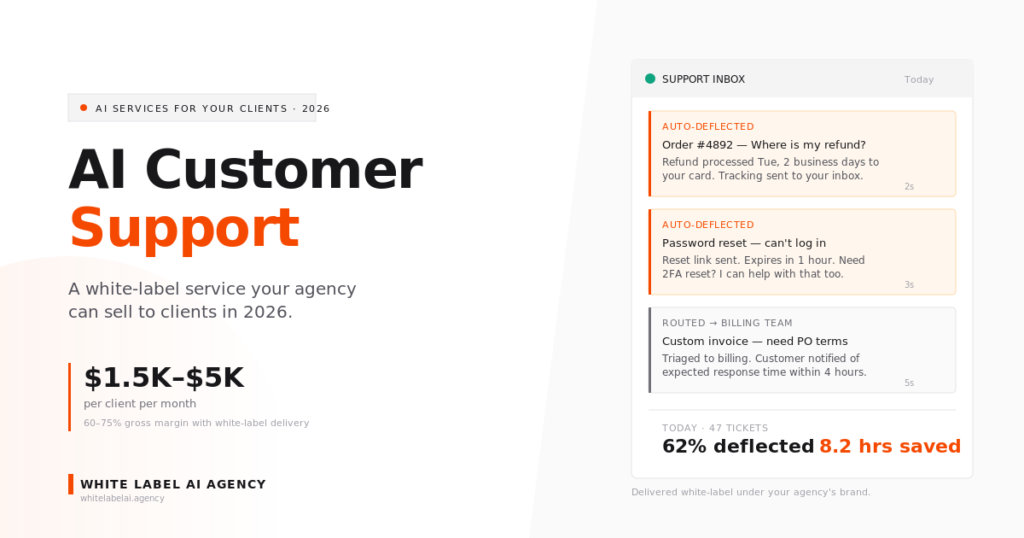
AI customer support is one of the easiest AI services for digital agencies to package, price, and sell to clients in 2026. Agencies productize a deflection bot, ticket triage, and knowledge-base assistant, charge clients $1,500 to $5,000 per month, and deliver it under their brand through a white-label partner. No internal AI team required.
The opportunity most agencies are leaving on the table
The AI customer support market is on track to hit $15.12 billion in 2026, growing at a 25.8% CAGR according to Grand View Research. 91% of businesses with 50+ employees already use AI chatbots somewhere in their customer journey (Lorikeet, 2026). Gartner projects $80 billion in contact center labor savings by the end of 2026 just from AI adoption.
Your agency clients are inside that statistic right now. Their support teams are drowning. They’ve been to a vendor demo or two. They’re going to spend on AI support in 2026. The only question is whether they spend it with you or with somebody else.
Most agencies aren’t selling AI support yet because the build-out feels technical: integrations, knowledge base structuring, escalation logic, ongoing tuning. That’s exactly why white-label delivery is the wedge. You sell the service, own the client relationship, and a white-label partner handles the technical execution.
The agencies that productized AI support in early 2026 are charging clients $1,500 to $5,000 per month per engagement. Wholesale delivery costs $400 to $1,500 per client through a white-label partner. Gross margin sits between 60% and 75% on a service that costs you almost no internal capacity to deliver. That’s why this is the first AI service most digital agencies should add to their menu.
What “AI customer support as a service” actually means
AI customer support as a service is a productized offering an agency sells to its clients that combines a deflection chatbot, ticket triage automation, and a knowledge-base assistant, all integrated into the client’s existing support stack and reported on monthly. The agency owns the client relationship, pricing, and brand. A white-label partner handles the implementation and ongoing tuning.
This is different from reselling a single tool like Intercom Fin or Freshworks Freddy. Reselling a tool is a license transaction. Selling AI support as a service means the agency is responsible for the outcome (the deflection rate, the resolution time, the CSAT impact) and reports those numbers back to the client every month.
The deliverable the client sees:
- A branded chat widget on their website with their company’s voice
- Ticket triage rules that route inbound queries to the right team
- A monthly performance report showing tickets deflected, hours saved, and CSAT change
- A named account contact (your agency’s account manager)
What the client never sees:
- The white-label partner doing the technical work
- The model-tuning, knowledge-base updates, and escalation rule changes happening in the background
- The integration layer connecting their CRM, support inbox, and KB
That separation is the entire reason this works.
The 5 components of a productized AI support offering
Every productized AI support engagement should ship with these five components. Anything less and you’re selling a chatbot, not a service. Anything more and the scope creeps until margins disappear.
1. Deflection bot on the client’s primary support channel. Web chat, in-app, or messaging. Pick one to start. The bot answers the high-volume, low-complexity queries (password resets, order status, business hours, policy questions). Industry benchmarks from Freshworks and others put well-implemented deflection rates at 45% on the lower end and 80–90% on category leaders.
2. Ticket triage and routing automation. Inbound tickets get auto-categorized, prioritized, and routed to the right team. This isn’t AI doing the resolution. It’s AI doing the dispatching, which alone cuts first-response time by 70–90% in most implementations.
3. Knowledge-base assistant. A search interface trained on the client’s docs, help center, and past tickets. Customers can self-serve more answers; the client’s support team can also use it internally to answer faster.
4. Escalation rules and human handoff. Clear paths for when the AI doesn’t know, when the customer is frustrated, when the issue is high-value. This is the trust layer. Without it, clients won’t sign.
5. Monthly performance reporting. Tickets deflected, hours saved, deflection rate trend, top unanswered queries, CSAT impact. This is what justifies the renewal.
You can sell this as a fixed-scope monthly retainer or a tiered offering (Starter, Growth, Enterprise). For most agencies, three tiers based on monthly ticket volume is the cleanest packaging.
What to charge clients
Pricing benchmarks across the market in 2026:
| Tier | Monthly ticket volume | Client price (monthly) | White-label delivery cost | Agency margin |
|---|---|---|---|---|
| Starter | Up to 1,000 tickets | $1,500–$2,500 | $400–$700 | 65–75% |
| Growth | 1,000–10,000 tickets | $2,500–$5,000 | $700–$1,500 | 60–72% |
| Enterprise | 10,000+ tickets | $5,000–$15,000+ | Custom | 50–65% |
These benchmarks come from agency pricing surveys (Digital Agency Network, 2026; Tidio chatbot pricing report, 2026; Crescendo agency pricing data, 2026). Your specific pricing depends on the verticals you serve, the integration complexity, and your local market.
A few pricing rules that hold up:
- Charge a setup fee. $500 to $5,000 depending on integration complexity. This funds the discovery and KB structuring work that has to happen before the bot goes live.
- Don’t price per resolved chat alone. Usage pricing sounds clean but creates incentive misalignment (the agency benefits from more chats, the client wants fewer). Flat-rate retainers with usage caps are cleaner.
- Bundle with your existing services. If you already manage the client’s website or support stack, AI support is a natural add-on, not a separate evaluation. The closure rate on add-ons runs 2 to 4 times higher than net-new sales.
For more on how agencies typically structure tiered AI service pricing, see our breakdown of how to price AI services for agencies and how agencies package AI services.
How to introduce AI support to existing clients (the upsell motion)
The fastest path to revenue isn’t selling AI support to net-new prospects. It’s introducing it to clients you already serve. Here’s the conversation that works:
The opener. “We’ve started rolling out AI customer support automation for our clients. Most are seeing 40 to 70% of their inbound tickets deflected within the first 60 days. Want me to walk you through what it would look like for your support inbox?”
The discovery. Ask three questions: (1) How many tickets does your support team handle per month? (2) What percentage of those are repeat questions? (3) What’s your average response time? You’re doing two things at once: qualifying the deal and giving the client numbers they can use to justify the investment internally.
The proposal. A one-page proposal with: scope (the 5 components above), pricing (your tier), expected outcomes (use the deflection benchmarks above with a 20% conservative haircut), timeline (30 days to live), and the monthly reporting they’ll receive. Don’t lead with features. Lead with the deflection number and the team hours saved.
The handoff. Once signed, your white-label partner does the build. You stay on the client communication, weekly check-ins, and monthly performance reviews. The whole engagement runs under your agency’s name.
For the agency operators reading this who haven’t sold productized AI services before, the AI services for agencies catalog shows what these conversations actually look like in practice.
Build, buy, or white-label: the agency decision
Three paths agencies typically consider for adding AI support to their service line.
| Build in-house | Buy and resell a tool | White-label delivery | |
|---|---|---|---|
| Time to first client live | 4–9 months | 1–3 months | 30 days |
| Upfront investment | $30K–$80K | $5K–$15K | $0 |
| Ongoing cost | Salary + tooling ($120K+/yr) | License fees | $400–$1,500/client/mo |
| Client relationship | Yours | Vendor’s logo on every interaction | Yours |
| Outcome accountability | Yours | Vendor’s | Yours, with partner support |
| Capacity ceiling | Limited by team | Limited by license | Scales with client base |
For agencies of 5 to 50 people in 2026, white-label is the lowest-risk path because the time-to-revenue is one month and the downside on a non-fit client is just a 30-day cancellation, not a sunk hire or a vendor lock-in.
Common mistakes agencies make selling AI support
Three patterns we see repeatedly when agencies first add this service:
Selling the bot, not the outcome. “We’ll add a chatbot to your site for $2K/mo” is a license sale. “We’ll deflect 50% of your tier-one tickets and report the savings monthly” is a service sale. The same delivery, completely different conversation. The second one renews.
Skipping the knowledge base prep. A bot is only as good as the content it can pull from. Half of the implementation work happens before the bot goes live: auditing existing help docs, restructuring for AI extractability, identifying gaps. Agencies that skip this step get poor deflection rates and lose the renewal.
Underpricing because the delivery feels easy. Wholesale delivery cost is $400 to $1,500 per client, so an agency might be tempted to price at $1,000. Don’t. The price reflects the outcome the client is buying, typically $20K to $80K per year in saved support team hours. Charge accordingly. Clients who balk at $2,500 a month for a service that saves them $4,000 a month in labor weren’t going to be good clients anyway.
Bonus benefit you can mention to your team: delivering AI support to clients also teaches your own agency how AI customer service works at depth. Your account managers, your support team, your operators all learn the product by selling and managing it. That’s the secondary value of doing this in 2026: you’re not just adding revenue, you’re building AI fluency across the team.
Frequently asked questions
What does “white-label” mean for AI customer support?
The agency owns the client relationship, the pricing, and the branding. The white-label partner handles the technical build and ongoing tuning behind the scenes. The client never sees the partner’s logo or hears from their team unless the agency chooses to introduce them. Reports, dashboards, and account communication all carry the agency’s identity.
What’s the typical deflection rate clients should expect?
Industry benchmarks in 2026 put well-implemented AI support at 45 to 70% deflection of inbound queries (Gartner, Freshworks). Category leaders reach 80 to 90% in narrow use cases. Most agency engagements quote 30 to 50% as a conservative target for the first 60 days, with optimization improving the number from there.
How long does it take to launch a client engagement?
Most engagements go live within 30 days from contract signing. The first 14 days handle discovery, knowledge base prep, and integration mapping. Days 15 to 25 are the build and internal testing. Days 26 to 30 are client UAT and go-live. Agencies running on standard support stacks (Zendesk, Intercom, Freshdesk, HubSpot Service) move fastest.
Can agencies offer AI support across multiple channels?
Yes. Most engagements start with one channel (typically web chat) and expand to in-app, messaging (WhatsApp, Messenger), and email after 60 to 90 days. Voice AI is the next layer, usually a separate service line at higher pricing.
What if the client already has a chatbot they’re unhappy with?
Replacement engagements are often the easiest sales because the client already knows their first attempt failed. Discovery focuses on what went wrong (usually: poor knowledge base, no escalation logic, no monthly reporting). Pricing for replacement engagements typically runs 20 to 30% higher than greenfield engagements because the client already understands the value.
What integrations are typically required?
The minimum set: the client’s helpdesk or ticketing system, their knowledge base or help center, and their identity layer if there’s authenticated content. Most modern AI support platforms have native integrations with the major helpdesks. Custom integrations add cost but are usually scoped during the discovery week.
How is performance measured and reported?
Five metrics monthly: deflection rate, average resolution time, tickets handled, top unanswered queries, and CSAT or NPS impact. The report is white-labeled with the agency’s brand and delivered as a PDF or live dashboard depending on the tier. The monthly review call is a natural retention touchpoint.
Should agencies build this in-house or use a white-label partner?
For agencies under 50 people, white-labeling is almost always the right call in 2026: first client live in 30 days, $0 upfront, and the partner handles the technical work. Above 50 people, building in-house starts to make economic sense if AI support is a core long-term service line. The decision is mostly about scale, not capability.
Ready to add AI customer support to your service menu?
Your agency’s clients are going to spend on AI support in 2026. The question is whether you sell it to them or watch it walk out the door to somebody else.
If you’d rather not spend 6 to 9 months building the capability internally, white-label delivery has you live with your first client engagement inside 30 days, with the technical execution handled under your brand.
We’ll walk through how white-label AI support delivery runs, what the first client engagement looks like, and how to position the service to your existing client base. No slide deck, no sales pressure. Just a working session.