The AI Maturity Model for Agencies: How to Move from Experimentation to Full Integration

Most agencies know AI matters.
Very few know what progress actually looks like.
Founders test ChatGPT. Teams automate a few tasks. Someone builds a Zap. Another person buys a tool. Six months later, nothing meaningful has changed.
Margins stay tight. Delivery stays manual. Services look the same. The agency feels “busy,” not better.
This is not an AI problem.
It is a maturity problem.
Agencies fail with AI because they treat adoption as a collection of experiments instead of a structured progression. Without stages, benchmarks, and intent, AI never compounds.
The agencies that win do one thing differently.
They move through a clear AI maturity model for agencies, step by step.
This article breaks that model down.
No hype. No tools list. Just the path from experimentation to full integration.
Why Agencies Need an AI Maturity Model
Unstructured AI adoption creates operational noise.
Teams pull in different directions. Systems never connect. Ownership stays unclear.
A maturity model gives leadership a map.
It clarifies what matters now and what can wait.
More importantly, it protects agencies from two costly mistakes:
- Overbuilding too early
- Staying shallow for too long
Agencies that adopt AI without a maturity lens usually stall at productivity gains. Agencies that follow stages turn AI into leverage.
What an AI Maturity Model Actually Means for Agencies
This model is not about being “advanced.”
It is about being intentional.
AI maturity measures how deeply AI is embedded into:
- Internal operations
- Delivery workflows
- Client services
- Decision-making systems
High maturity does not mean more tools.
It means fewer tools doing more work.
For agencies, maturity always starts internally.
Client-facing AI only works after operations stabilize.
Stage 1: Awareness and Experimentation
This is where nearly every agency begins.
What this stage looks like
- Founders test ChatGPT for writing and research
- Team members try prompts on their own
- AI is optional and untracked
- No workflows change
The wins feel exciting at first.
Copy gets faster. Ideas come quicker. Small tasks shrink.
The hidden risk
Nothing compounds.
Knowledge stays locked in individuals.
Results depend on who remembers to use AI.
Agencies that stay here too long mistake activity for progress.
They feel modern without becoming stronger.
Signal you are stuck here
- AI saves time but does not change delivery
- No internal standards exist
- Leadership cannot explain how AI supports revenue
Stage 2: Tactical Adoption
At this stage, agencies start assigning AI to tasks.
What changes
- AI helps with content drafts
- Sales research becomes faster
- Support replies use templates
- Automation tools connect small processes
Productivity improves.
Teams feel relief.
Why agencies plateau here
AI usage stays task-based, not workflow-based.
Every function optimizes in isolation.
One tool handles content.
Another handles CRM.
Nothing shares context.
The agency moves faster but remains fragile.
Signal you are here
- Clear time savings exist
- AI tools vary by department
- No central AI ownership or roadmap
Stage 3: Operational Integration
This is where real maturity begins.
What changes
AI becomes part of how work flows, not just how tasks execute.
Examples:
- Content workflows include AI at each step
- Lead qualification runs through AI scoring
- Project updates auto-generate from activity
- SOPs reference AI inputs explicitly
Processes become predictable.
Quality stabilizes.
Why this stage matters
Margins start to improve here.
Not because people work harder, but because systems remove friction.
This is also where leadership gains visibility.
They can finally answer, “What is AI doing for us?”
Signal you are here
- AI appears inside SOPs
- Fewer handoffs exist
- Delivery speed improves without burnout
Stage 4: Service-Level Integration
Most agencies never reach this stage.
Those that do pull away fast.
What changes
AI becomes part of what clients pay for.
Not as a buzzword.
As embedded capability.
Examples:
- AI-assisted reporting
- Automated insights dashboards
- Faster campaign iteration cycles
- AI-supported lead handling
Clients feel the difference.
Sales calls change tone.
Instead of “we do marketing,” the agency explains systems.
The challenge
Delivery consistency becomes critical.
You cannot sell AI-enhanced services without stable operations.
This is why Stage 3 always comes first.
Signal you are here
- AI features appear in proposals
- Clients notice faster turnaround
- Retainers feel easier to deliver
Stage 5: AI-Native Agency Model
This stage changes how the agency thinks.
What defines AI-native
AI handles execution.
Humans handle strategy, judgment, and relationships.
Systems make decisions faster than people can.
The agency scales without linear hiring.
What shifts operationally
- Fewer roles focus on production
- More roles focus on orchestration
- Decision loops shorten
- New service models emerge
At this stage, AI is infrastructure.
Turning it off would break the business.
Signal you are here
- Headcount grows slower than revenue
- Delivery adapts without manual intervention
- The agency feels calm even while scaling
The Visual Breakdown of the AI Maturity Model
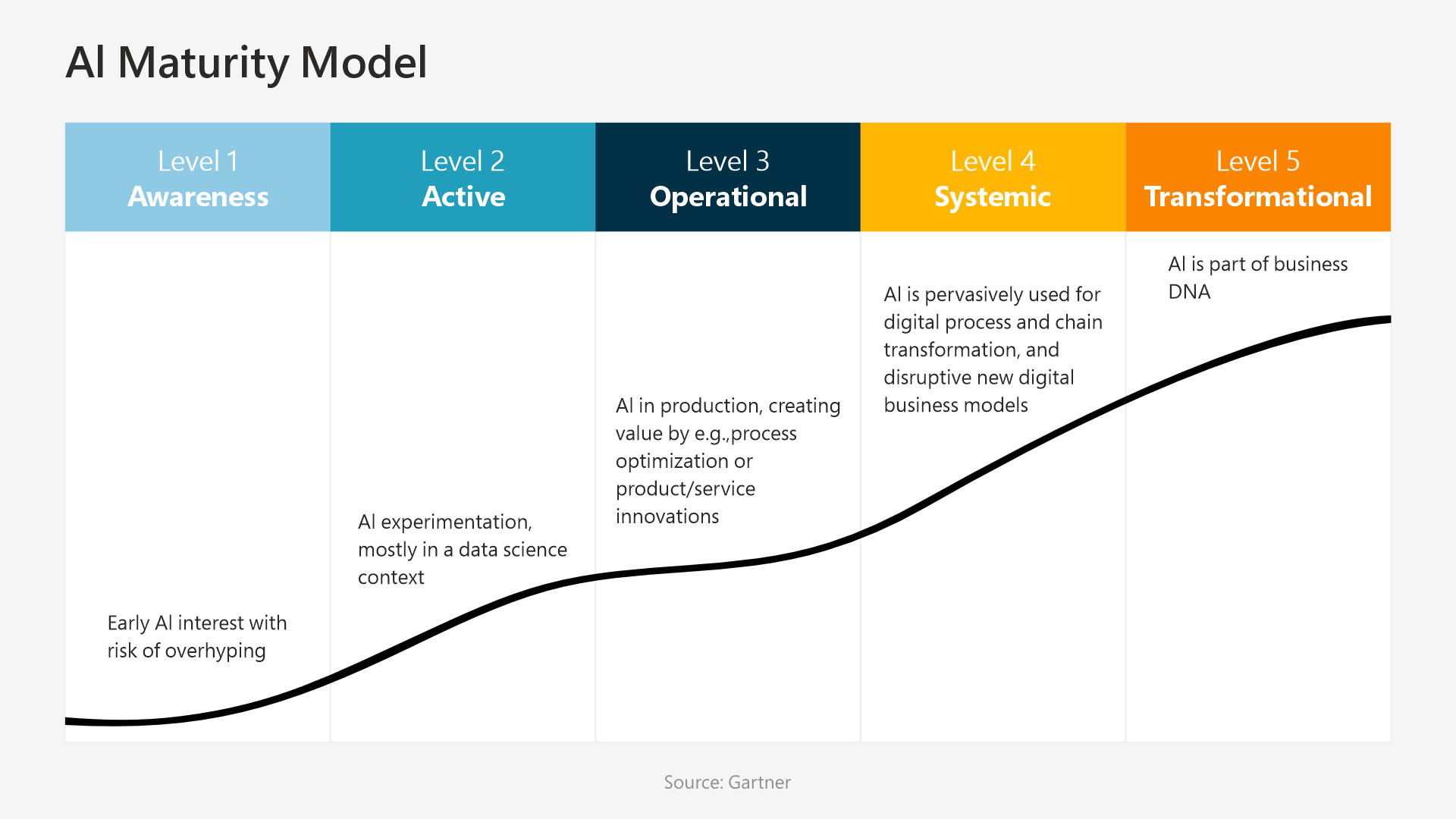
Each stage builds on the previous one.
Skipping stages creates chaos.
The fastest agencies do not rush.
They sequence.
Common Mistakes That Stall AI Maturity
Tool-first thinking
Buying tools before designing workflows leads to clutter.
Tools should serve systems, not replace them.
Overbuilding internally
Agencies try to engineer everything themselves.
This slows progress and drains focus.
Ignoring team enablement
AI fails when teams fear it or misuse it.
Training and clarity matter more than prompts.
Chasing novelty
New models appear weekly.
Mature agencies ignore noise and double down on stability.
How to Assess Your Agency’s Current AI Maturity
Ask these questions honestly.
Operations
- Are workflows AI-aware or AI-optional?
- Can someone new follow an AI-enabled SOP?
Revenue
- Does AI increase margin or just save time?
- Do clients pay more because of AI?
Leadership
- Is there a documented AI roadmap?
- Does someone own AI decisions?
Most agencies overestimate their maturity.
Time saved does not equal integration.
How Agencies Accelerate Maturity Without Burning Time
This is where strategy matters.
Build only what creates advantage
Internal orchestration and data context matter.
Commodity automation does not.
Partner instead of reinventing
White-label AI partners reduce risk.
They bring proven systems, not experiments.
Focus on compounding layers
Each stage should unlock the next.
Do not optimize sideways.
This is why many agencies partner with WhiteLabelAI.Agency instead of hiring full AI teams.
The goal is speed with control.
What High-Performing Agencies Understand About AI Maturity
AI maturity is not about being early.
It is about being ready.
The agencies that win treat AI like financial infrastructure.
They plan, stage, and invest with intent.
They do not chase tools.
They build systems that survive change.
Where This Leaves You as an Agency Owner
AI is no longer optional.
But reckless adoption is expensive.
The AI maturity model for agencies gives you leverage without chaos.
It replaces guesswork with sequence.
If your agency is experimenting, that is fine.
If it stays there, it is at risk.
The next step is not more tools.
It is a roadmap.
And the agencies that act on that reality now will control margins, delivery, and differentiation while others scramble to catch up.