AI Tools vs AI Systems for Clients

AI Tools vs AI Systems for Clients is not a technical debate. It is a business survival question.
Many agencies promise AI. However, most only deliver tools. Clients expect transformation. Instead, they get dashboards.
Understanding the difference is the gap between short-term experimentation and long-term competitive advantage. This guide breaks it down clearly, so you can stop confusing automation with strategy.
What Are AI Tools?
AI tools are standalone applications powered by artificial intelligence.
They perform a specific task. Nothing more.
Examples include:
- Content generators like OpenAI tools
- Workflow automation platforms like Zapier
- CRM add-ons inside HubSpot
These tools increase speed. They reduce manual work. However, they operate in isolation.
Key Characteristics of AI Tools
- Task-specific
- User-triggered
- Reactive
- Limited integration
- Dependent on human direction
They are helpful. But they are not strategy.
What Are AI Systems?
AI systems are structured, integrated frameworks.
They connect data, workflows, decision logic, and automation into a unified process.
Unlike tools, systems operate continuously. They improve over time. They reduce decision friction.
An AI system may include multiple tools. However, the system defines the outcome.
Key Characteristics of AI Systems
- End-to-end automation
- Cross-platform integration
- Data feedback loops
- Predictive optimization
- Outcome-focused design
Tools execute. Systems think in workflows.
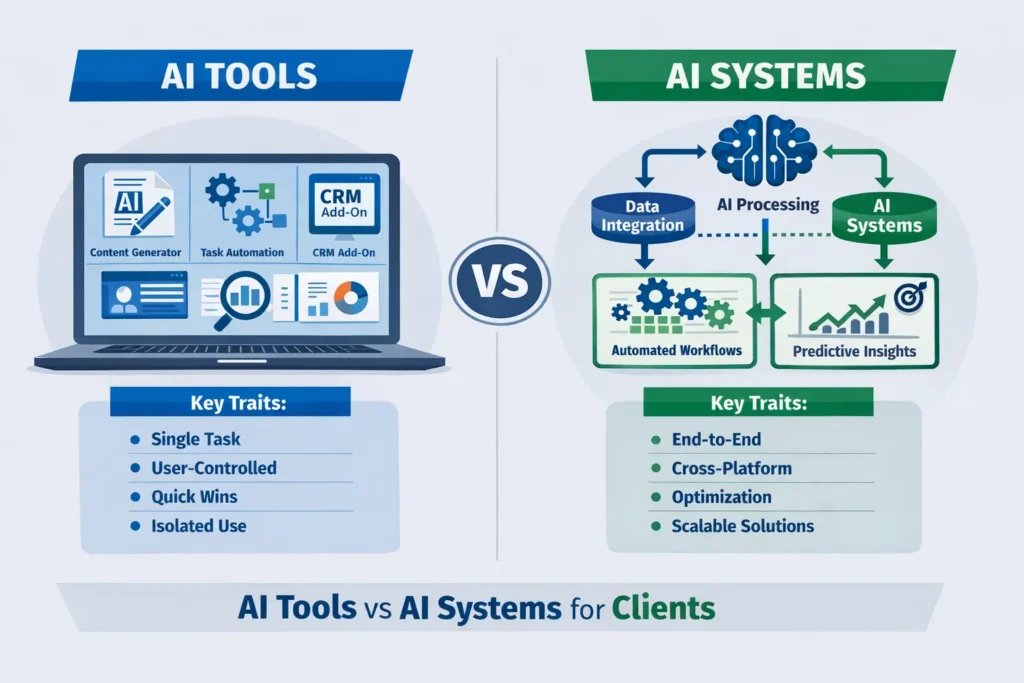
AI Tools vs AI Systems for Clients — The Core Differences
| Category | AI Tools | AI Systems |
| Scope | Single function | End-to-end process |
| Ownership | User-driven | Architect-driven |
| Value | Efficiency | Transformation |
| Scalability | Limited | Compounding |
| Client Perception | Tactical | Strategic |
This is where agencies fail.
They sell subscriptions. Clients expect transformation.
Why Clients Get Confused
Clients hear “AI.” They assume intelligence.
In reality, they often receive a login.
However, business leaders care about outcomes:
- Revenue growth
- Reduced acquisition costs
- Faster decision cycles
- Better customer retention
AI tools do not guarantee these results. Systems are designed around them.
Therefore, the real conversation is not about software. It is about architecture.
When AI Tools Are Enough
AI tools make sense when:
- The client needs quick wins
- Budget is limited
- Internal teams can manage workflows
- The problem is narrow
For example, adding automated email generation inside Mailchimp may solve a specific productivity issue.
However, it will not redesign the entire customer journey.
Tools are accelerators. Not infrastructure.
When Clients Need AI Systems
AI systems become essential when:
- Multiple tools create fragmentation
- Data lives in silos
- Reporting is manual
- Decision-making is reactive
A proper AI system connects CRM, marketing automation, analytics, and sales workflows.
For example, integrating data intelligence with platforms like Salesforce allows predictive scoring instead of reactive follow-ups.
Systems reduce chaos.
And chaos is expensive.
The Business Impact — Efficiency vs Compounding Growth
AI tools improve productivity.
AI systems create compounding leverage.
That difference matters.
Efficiency saves hours. Systems reshape revenue models.
Over time, clients who invest only in tools hit a ceiling. Meanwhile, system-driven companies build durable advantage.
Common Mistakes Agencies Make
Let’s be blunt.
- Selling tools as transformation
- Overpromising automation
- Ignoring integration
- Avoiding architecture discussions
- Focusing on features instead of outcomes
Clients do not buy AI tools.
They buy predictable results.
If your offer cannot connect inputs to revenue outputs, it is not a system.
How to Position AI Tools vs AI Systems for Clients
If you are advising clients, your positioning matters.
Step 1: Audit Their Current Stack
Map every tool. Identify redundancies.
Step 2: Identify Process Breakdowns
Where is friction? Where is manual work hiding?
Step 3: Design the System First
Choose tools second.
Most agencies reverse this.
That is backwards.
Framework to Explain It to Clients
Use this simple distinction:
- Tools answer: “Can we automate this task?”
- Systems answer: “How should this entire process run?”
When you elevate the conversation, you elevate your authority.
Future Outlook — AI Is Moving Toward Systems
The market is shifting.
Standalone tools are becoming commodities.
Meanwhile, competitive advantage is moving toward integrated systems powered by APIs, data orchestration, and predictive models.
According to research from McKinsey & Company, companies that embed AI across workflows outperform those using isolated applications.
That trend will accelerate.
Final Verdict — AI Tools vs AI Systems for Clients
AI Tools vs AI Systems for Clients is not a technical nuance.
It is the difference between selling subscriptions and building infrastructure.
Tools create activity.
Systems create alignment.
Alignment creates growth.
If you want long-term client retention, build systems.
If you want short-term billing spikes, sell tools.
Choose accordingly.