
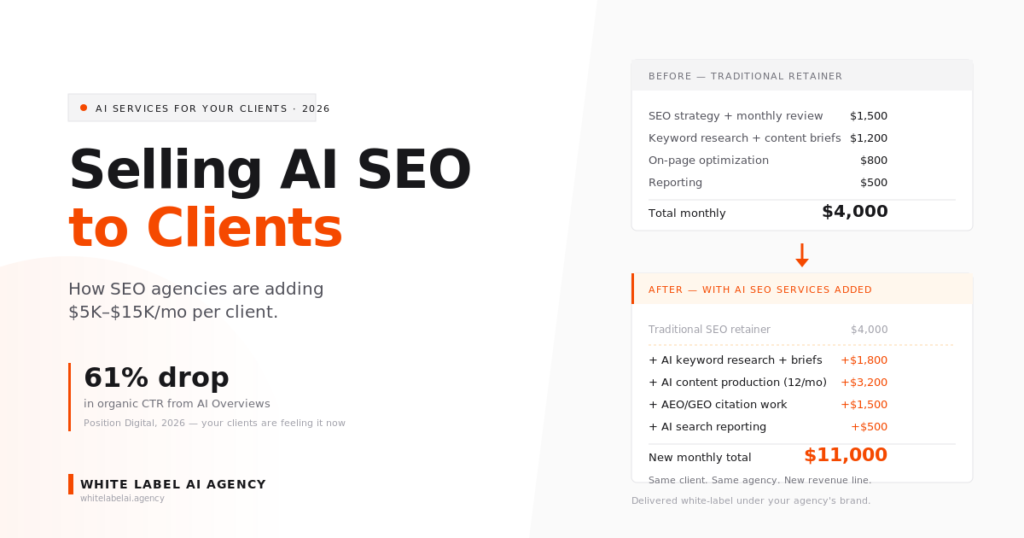
White label AI SEO services let SEO agencies sell AI-powered keyword research, content briefs, schema markup, and AEO/GEO optimization to their clients as a new service line. Layered onto existing SEO retainers, AI SEO services typically add $5,000 to $15,000 per month per client. White-label delivery handles the technical execution under the agency’s brand. No new hires required.
Why client SEO budgets feel flat in 2026 (and what to do about it)
Your clients’ organic traffic is dropping. Not because their SEO is broken. Because the rules changed.
As of March 2026, 65.07% of Google search results pages now include AI Overviews, up from 25% in August 2024 (SEM Nexus). AI Overviews reduce organic click-through rate by 61% on average (Position Digital, 2026 AI SEO statistics). Roughly 60% of searches now end without a click, with the user getting their answer from the AI summary at the top of the page. By end of 2026, Gartner expects 25% of organic search traffic to shift entirely to AI chatbots and voice assistants.
Your clients are seeing this in their analytics right now. They don’t have language for it yet, so they’re calling it “the SEO slowdown” or “Google getting weird.” What they’re actually seeing is the migration of search traffic from blue links to AI answers, and most SEO programs aren’t built for that.
This is the opening. If your agency walks in with an AI SEO service offering before the client raises the issue, you’re the partner who saw it coming. If you wait until the client asks, you’re already on the defensive, and they’re already shopping. The agencies adding the most revenue right now aren’t winning new logos — they’re converting flat traditional SEO retainers into expanded AI SEO retainers with the clients they already serve.
For a deeper look at how AI search visibility specifically works, our companion post on GEO for agencies covers the citation-earning mechanics in detail.
What “AI SEO services” actually mean
AI SEO services are a productized agency offering that combines AI-powered keyword research, content briefs and production, on-page optimization, schema markup, AEO and GEO citation work, and AI-search reporting. The client receives a delivery layer that protects their organic visibility through both traditional Google rankings and AI search engine citations. The agency owns the strategy and reporting. A white-label partner handles the technical execution.
The deliverable is bigger than “we use AI to do SEO faster.” That’s an internal tool change, not a new service line. AI SEO as a service has six concrete components clients can see, name, and pay for separately:
1. AI keyword research with intent classification. Pulls 500 to 5,000 keyword ideas per project, classifies each by search intent (informational, commercial, transactional, navigational), and flags AI-Overview risk. Output is a spreadsheet the client uses to prioritize what to build content for.
2. AI-powered content briefs at scale. Brief generation that includes SERP analysis, recommended H1/H2 structure, target word count, semantic keyword coverage, and competitor coverage gaps. What used to take a strategist 90 minutes per brief now takes 8 minutes with editorial review.
3. Production-ready content with editorial layer. AI-drafted long-form content with a human editorial pass for voice, fact-check, and structural integrity. Volume scales from 4 to 40+ pieces per client per month without proportional team growth.
4. On-page optimization and schema deployment. Title tags, meta descriptions, internal linking, schema markup (Article, FAQPage, HowTo, Organization, Product). This is the layer that determines whether content gets cited in Google AI Overviews — 76.1% of AI Overviews citations also rank in Google’s top 10 (Trio SEO, 2026), so on-page work directly drives AI visibility.
5. AEO and GEO citation work. Entity audits, knowledge base structuring, third-party citation building, and direct answer block deployment to win citations in ChatGPT, Perplexity, and Gemini. New citations typically appear within 30 to 60 days. Durable presence takes 4 to 6 months.
6. AI-aware monthly reporting. Traditional metrics (rankings, traffic, conversions) plus AI search visibility metrics (citations earned per AI engine, AI referral traffic in GA4, share of voice in target queries). The reporting layer is what justifies the higher retainer at renewal time.
This is a six-part deliverable, not a tool. That distinction is the whole reason it sells.
The agency revenue math
Pricing benchmarks across the AI SEO services market in 2026:
| Tier | Client size | Deliverable scope | Monthly client price | Wholesale delivery cost | Agency margin |
|---|---|---|---|---|---|
| Starter | SMB / local | 1 ICP, 4 pieces/mo, basic AEO/GEO | $2,500–$5,000 | $700–$1,500 | 65–75% |
| Growth | Mid-market | 2–3 ICPs, 8–15 pieces/mo, full AEO/GEO | $5,000–$10,000 | $1,500–$3,000 | 60–72% |
| Enterprise | National / multi-location | Multi-ICP, 20+ pieces/mo, technical + AEO/GEO | $10,000–$25,000+ | $3,000–$6,000+ | 55–65% |
These ranges come from agency pricing surveys (Embarque white-label pricing, ALM Corp 2026 white-label SEO guide, Onely AI SEO agency review). Specific pricing depends on vertical, geography, and agency positioning.
A few pricing rules that hold in this market:
Don’t replace the existing SEO retainer. Add AI SEO as a separate line item, even if some of the work overlaps. Bundling makes the value invisible. A client paying $4,000/mo for traditional SEO who adds $4,000/mo of AI SEO services is paying $8,000/mo total. That same client at $7,500/mo “for SEO” feels overcharged.
Charge a structured setup fee. $2,500 to $7,500 for the entity audit, content brief library setup, schema deployment, and AEO/GEO baseline. This funds the upfront work that has to happen before recurring delivery starts paying back.
Tie pricing to outcomes the client cares about. Citations earned, AI Overview visibility share, organic traffic protected. The reporting line in the proposal sells the renewal six months from now.
For more detail on layered pricing for AI agency services, see our breakdown of how to price AI services for agencies and how agencies package AI services.
How to introduce AI SEO to an existing client retainer (the upsell motion)
The agencies converting fastest are running this exact motion with their existing client base. Most SEO agencies have 15 to 60 clients on retainer right now. If 30% accept an AI SEO add-on at $5,000/mo, that’s $22,500 to $90,000 in new monthly recurring revenue inside 90 days. From clients you already serve.
The four-step conversation that works:
Step 1: The audit hook. “Want me to run an AI search visibility audit on your site this month? Free. We’ll show you which queries you’re losing to AI Overviews, where you’re being cited or not cited in ChatGPT and Perplexity, and what the next 6 months of AI search means for your traffic.” Most clients say yes because the audit costs them nothing and the data is interesting.
Step 2: The audit reveal. Walk them through the audit findings. Three numbers anchor the conversation: (a) the percentage of their target queries that now show an AI Overview, (b) their current citation count in ChatGPT and Perplexity (usually zero), (c) the projected traffic decline if they don’t adapt. This is data, not a sales pitch. The client draws their own conclusion.
Step 3: The proposal. A one-page proposal layered onto their existing retainer: scope (the 6 components above), pricing (your tier), expected outcomes (citation count, AI visibility share, organic traffic protected), timeline (30 days to first deliverable). Don’t lead with features. Lead with the revenue or traffic the AI SEO program will preserve.
Step 4: The handoff. Once signed, your white-label partner does the technical execution. You stay on strategy, the monthly review call, and the client communication. The whole engagement runs under your agency’s name.
For agencies that haven’t sold productized AI services before, the AI services for agencies catalog shows what these conversations actually look like.
Build, buy, or white-label: the agency decision
Three paths SEO agencies typically consider for adding AI SEO to their service line.
| Build in-house | Buy a tool stack | White-label delivery | |
|---|---|---|---|
| Time to first client live | 4–8 months | 1–2 months | 30 days |
| Upfront investment | $40K–$120K | $5K–$20K | $0 |
| Ongoing cost | Salary + tooling ($150K+/yr) | License fees | $700–$3,000/client/mo |
| Outcome accountability | Yours | Vendor’s | Yours, with partner support |
| Scales beyond first hire | No (linear with team) | No (linear with licenses) | Yes (scales with clients) |
| Risk if it doesn’t work | Sunk cost | License lock-in | Cancel in 30 days |
For SEO agencies of 1 to 50 people in 2026, white-labeling is almost always the right call because the time-to-revenue is one month and the per-client unit economics work even on starter tier engagements. Above 50 people, building in-house starts to make sense if AI SEO will be a core long-term service line. The decision is mostly about scale, not capability.
White-label AI delivery handles the technical layer including AI keyword research tooling, content production at volume, schema deployment, AEO/GEO entity work, and the citation tracking infrastructure. The agency owns the client relationship and the monthly strategy review.
The 4 mistakes SEO agencies make selling AI SEO
We see the same four patterns repeatedly when SEO agencies first add this service line:
Selling tools, not outcomes. “We use SurferSEO and Frase to write optimized content” is a tool conversation. “We’ll preserve your organic traffic against AI Overview erosion and earn you citations in ChatGPT” is an outcome conversation. The same delivery, completely different proposal. Outcomes get the renewal.
Lumping AI SEO into the traditional retainer at no charge. Free is not generous. Free is what kills perceived value. If the client is already paying for SEO and you start delivering AI SEO without naming it as a separate service, you’ve doubled your work for the same revenue and trained the client to expect AI-included pricing forever. Always price AI SEO as a separate line item.
Skipping the entity layer. AI SEO is downstream of entity authority. If your client doesn’t have a complete Wikidata or Crunchbase entry, consistent NAP across the web, and proper Organization schema with sameAs links, every other AI SEO investment underperforms. Half of our GEO for agencies framework is the entity layer.
Treating AI SEO as a one-time project. Citations decay. Perplexity demotes stale content aggressively. Google AI Overviews prefer pages updated within the last 12 months. AI SEO is a recurring discipline like traditional SEO, not a campaign with a finish line. Pricing must reflect that. If you’re scoping AI SEO as a 90-day engagement, you’ve miscoded it.
The internal-use bonus: SEO agency teams that deliver AI SEO services to clients build deep AI competence faster than teams that don’t. Your strategists, content team, and account managers learn the AI search layer by selling and operating it. That’s the secondary value of doing this in 2026: you’re not just adding revenue, you’re future-proofing the agency’s core capability.
Frequently asked questions
What’s the difference between “AI-powered SEO” and “AI SEO services”?
AI-powered SEO is when an agency uses AI tools internally to do SEO work faster. The client never sees it as a distinct line item. AI SEO services is a separately-named, separately-priced offering an agency sells to clients that includes AI-powered keyword research, content briefs, on-page optimization, AEO/GEO citation work, and AI search reporting. The first is an internal efficiency play. The second is a revenue play.
Do clients understand the difference between SEO and AEO/GEO?
Not yet, but they’re catching up fast. Most clients in mid-2026 understand that “Google is putting AI answers at the top now” but don’t have language for AEO or GEO. Use plain language in client-facing materials: “AI search visibility,” “getting cited in ChatGPT and Perplexity,” “protecting traffic against AI Overviews.” Save the acronyms for internal documentation.
Should AI SEO replace traditional SEO retainers?
No. Layer it. Traditional SEO and AI SEO solve overlapping but distinct problems. Traditional SEO targets ranking in Google’s top 10 organic results. AI SEO targets visibility in AI Overviews, ChatGPT citations, Perplexity citations, and Gemini answers. 76.1% of AI Overviews citations still come from pages ranking in Google’s top 10 (Trio SEO, 2026), so traditional SEO is the foundation. AI SEO is the additional layer that converts traditional rankings into AI citations.
How long does AI SEO take to show results?
First citations typically appear within 30 to 60 days for well-structured content. Durable presence in AI search across multiple engines (ChatGPT, Perplexity, Gemini, Google AI Overviews) takes 4 to 6 months. Category dominance for competitive terms is a 9 to 12 month effort. These timelines are similar to traditional SEO, but the metrics being tracked are different.
Can SEO agencies offer AI SEO without hiring AI specialists?
Yes. White-label AI delivery handles the technical layer (entity work, schema deployment, content production at volume, citation tracking) under the agency’s brand. The agency owns the strategy, client relationship, and reporting. For agencies under 50 people, this is almost always more economical than hiring a specialist with the right blend of SEO + structured data + content production skills.
What happens to traditional SEO services as AI SEO grows?
Traditional SEO services continue, but the value proposition shifts. Pure ranking-focused SEO retainers face pricing pressure. Agencies that bundle AI SEO into a broader “AI search visibility” service line are protecting margins. Agencies that don’t are watching client renewals stall. The shift mirrors what happened with social media services in 2014–2017: separate line items eventually got bundled, but the agencies that priced the new layer separately for several years captured the most revenue.
How is AI SEO performance measured?
Five categories of metrics: traditional rankings (top 10 positions), traditional traffic (organic clicks from Google), AI search visibility (citation count per engine, share of answers for target queries), AI referral traffic (GA4 segments for chatgpt.com, perplexity.ai, gemini.google.com), and conversion impact (assisted conversions from AI search sources). Reports should cover all five monthly. Tools like Ahrefs Brand Radar and Peec AI automate citation tracking; for the first 90 days a Google Sheet works fine.
Is white-labeling AI SEO services different from white-labeling traditional SEO?
Yes, in two ways. First, the technical scope is broader (entity work, schema, AEO/GEO are typically not in traditional white-label SEO scopes). Second, the reporting layer is more involved because AI search has no Search Console equivalent. Most traditional white-label SEO providers don’t yet offer the AEO/GEO layer, which is why agencies often switch partners when adding AI SEO.
Ready to add AI SEO to your agency’s service menu?
Your existing clients are losing organic traffic to AI Overviews and AI chatbots right now. The agencies they’re talking to next will be the ones with an answer for that.
If you’d rather not spend 4 to 8 months building AI SEO capability internally, white-label delivery has you live with your first client engagement inside 30 days, with the technical execution handled under your agency’s brand.
We’ll walk through how white-label AI SEO delivery runs, what the first client engagement looks like, and how to position the service to your existing client base. No slide deck, no sales pressure. Just a working session.