
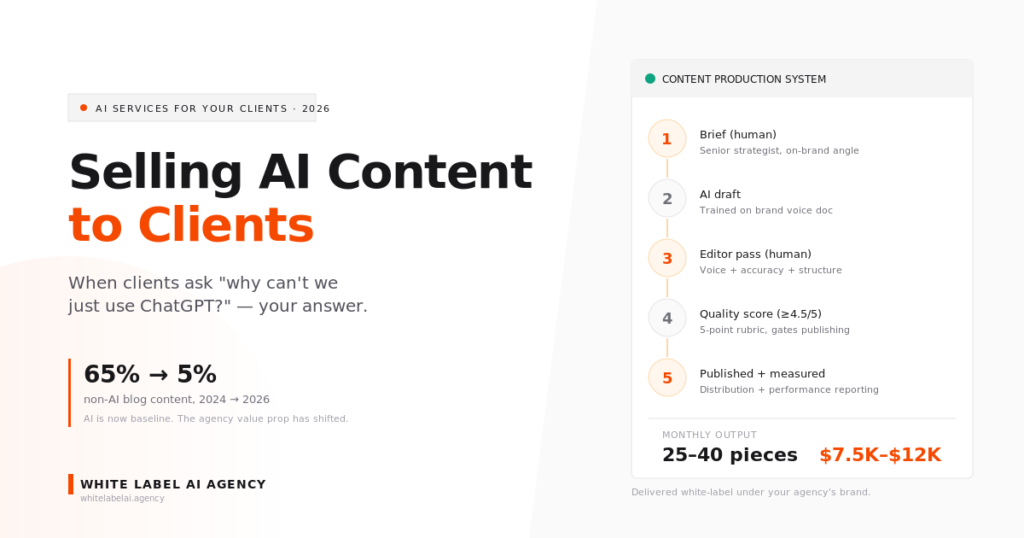
White label AI content production lets agencies sell scalable content services to clients in 2026 (blog, social, ads, email) with an editorial layer that keeps quality on-brand. Agencies charge $3,000 to $25,000 per month and deliver under their brand through a white-label partner. AI content production is a $24B market in 2026, and agencies without a productized offer are losing renewals.
Why most content agencies are losing engagements right now
The numbers are uncomfortable. Non-AI blog creation dropped from 65% of all blog content in 2024 to just 5% in 2026 (Affinco, 2026 AI Content Statistics). 94% of marketers now use AI for content production. Agencies running AI workflows are shipping a median of 17 articles per month versus 12 without AI, a 42% volume lift, with content output rising 77% in the first six months of AI adoption (Typeface State of AI in Marketing, 2026).
Your clients have read these statistics too. They’re sitting in their team meetings asking why the agency content retainer costs the same as it did pre-AI when ChatGPT, Claude, and Gemini are sitting on every laptop. Some of them have already canceled. The ones who haven’t are negotiating you down or asking for “more volume at the same rate.”
This is the conversation most content agencies are losing in 2026. Not because AI replaced them. Because the agency value proposition didn’t shift fast enough. The agencies still selling “we’ll write 8 blog posts a month for $4,000” are pricing against ChatGPT, and they’re going to lose. The agencies repackaging the offer as “we’ll run a quality-controlled AI content production system that ships 24 pieces of measurable, on-brand content per month for $7,500” are growing.
The reframe is everything. Your clients are not buying writing anymore. They’re buying a production system with editorial quality control, brand voice consistency, distribution, and measurement. AI is the engine. The agency operates it.
For a parallel argument on the SEO side of the same shift, see how SEO agencies are reframing AI SEO services.
What “AI content production as a service” actually means
AI content production as a service is a productized agency offering that combines AI-powered ideation, brief generation, draft production, editorial review, optimization, and distribution across the client’s content channels. The agency owns strategy, brand voice guidelines, and the client relationship. A white-label partner handles the production volume and the technical layer.
The deliverable is a system, not a stack of articles. The same way nobody buys “12 social media posts” anymore, no one buys “8 blog posts” as a unit of value. Clients buy outcomes: organic traffic protected, leads generated per channel, brand voice consistency across 200+ pieces of monthly content. The output is measured by what it produces, not what it is.
The deliverable the client sees:
- A monthly content calendar mapped to their funnel
- Published content (blogs, social, email, ad copy, landing pages, case studies) on schedule
- A monthly performance report showing traffic, engagement, conversion contribution
- A named editor or account lead from the agency
What the client never sees:
- The white-label partner running the AI tooling stack
- The model orchestration (which AI does which part of the workflow)
- The deliverability and distribution layer
- The QA and brand-voice training infrastructure
That separation is the entire margin engine.
The 4 ways to package AI content for clients
Different clients buy content for different reasons. The packaging that converts depends on which problem the client actually has. Four models that work in 2026:
1. The volume play. For clients who need significantly more content than they currently produce. Pitch: “We’ll triple your content output without tripling your budget.” Typical scope: 20 to 40+ pieces per month across blogs, social, email, ads. Pricing: $5,000 to $12,000 monthly retainer. Best fit: SaaS, e-commerce, content-heavy verticals where volume drives organic traffic.
2. The premium-quality play. For clients who are anxious about AI content quality and need reassurance. Pitch: “AI does the heavy lifting; senior editors do the polish. You get content indistinguishable from human-written, at half the timeline.” Typical scope: 8 to 15 pieces per month with deep editorial review. Pricing: $7,500 to $18,000 monthly retainer. Best fit: B2B, finance, healthcare, legal, where brand voice and accuracy matter more than volume.
3. The hybrid editorial play. For clients who already have an internal team and want to multiply their capacity. Pitch: “Your team writes the strategic pieces; our system produces everything else under your editorial direction.” Typical scope: AI handles 70% of volume (briefs, drafts, supporting content), the client’s team handles 30% (cornerstone content, thought leadership). Pricing: $4,000 to $8,000 monthly. Best fit: enterprises with internal content teams who need scale without losing voice.
4. The channel-bundled play. For clients who buy by channel (social-only, email-only, blog-only). Pitch: “All your content for one channel, fully managed.” Typical scope: deep specialization in one or two formats with weekly cadence. Pricing: $2,500 to $6,000 per channel per month. Best fit: agencies whose clients want narrow, deep services rather than broad content programs.
Most successful agency engagements pick one model per client and stick to it for at least 6 months before considering expansion. Mixing models inside one engagement makes pricing impossible to defend.
For a deeper look at agency packaging principles, see how agencies package AI services.
Pricing structures that work in 2026
The biggest mistake content agencies are making in 2026 is keeping the per-piece pricing model. Per-piece worked when the unit cost was a writer’s hourly rate. With AI in the workflow, per-piece pricing telegraphs to the client that you’re charging $400 for something AI produced in 12 minutes. Reframe.
Three pricing models that hold up:
| Model | How it works | When to use it | Margin profile |
|---|---|---|---|
| Outcome-based retainer | Flat monthly fee for a defined outcome (organic traffic %, leads per month, content reach metric) | Mid-market clients with clear KPIs | High: 60–75% with white-label delivery |
| Volume-bundled retainer | Flat monthly fee for a content quota across channels (e.g., 4 blogs + 20 social posts + 8 emails) | SMB and growth-stage clients | Medium-high: 55–70% |
| Channel-bundled retainer | Flat monthly fee per channel program (blog program, social program) | Specialist clients buying narrow services | Medium: 50–65% |
Avoid these structures in 2026:
- Per-piece pricing (forces a comparison to ChatGPT prompt cost)
- Hourly pricing for content production (telegraphs that you’re billing for time AI replaced)
- Mixed pricing inside one engagement (impossible to defend at renewal)
Pricing benchmarks across the AI content services market (sourced from Sight AI 2026 pricing guide, Digital Agency Network, WorkFX AI 2026 enterprise pricing):
| Tier | Scope | Monthly client price | Wholesale delivery cost | Agency margin |
|---|---|---|---|---|
| Starter | 8–12 pieces, 1 channel | $3,000–$5,000 | $700–$1,500 | 65–75% |
| Growth | 20–30 pieces, 2–3 channels | $5,000–$10,000 | $1,500–$3,000 | 60–72% |
| Premium / Enterprise | 30+ pieces, full content program with editorial leadership | $10,000–$25,000+ | $3,000–$7,500 | 55–65% |
For more on layered AI services pricing, how to price AI services for agencies covers the structural decisions in detail.
The editorial layer (where humans stay in the loop)
The reason clients pay agencies instead of using ChatGPT directly is the editorial layer. In production, the editorial layer has five concrete checkpoints:
1. Brand voice document. Built once per client during onboarding. Captures vocabulary, prohibited phrases, tone calibration, sentence rhythm patterns, examples of on-brand and off-brand writing. Used as a system prompt and a QA reference. This is the single most important deliverable in the first 30 days; without it, every AI-drafted piece reads generic.
2. Brief-level human review. A senior strategist reviews every brief before AI drafts. Briefs include the angle, target keyword, intent, structure, internal link map, CTA, and any client-specific requirements. AI drafting against a strong brief produces 5x better output than AI drafting against a vague topic.
3. Draft-level editorial review. Every AI-drafted piece gets a human editor’s pass for accuracy, voice consistency, structural integrity, and any factual claims that need verification. Good editors finish a 1,500-word draft review in 25 to 40 minutes. Bad editors leave AI artifacts (hallucinations, repeated phrases, generic openers) in production. Hire well.
4. Quality scoring. Each piece scored on a 5-point rubric (voice match, accuracy, structure, originality, conversion clarity). Pieces below threshold cycle back. Most engagements target 4.5+ average across the month. The score becomes part of the monthly client report, giving the client quantitative proof of the editorial layer’s value.
5. Compliance and fact-check pass. For regulated industries (finance, healthcare, legal) or any factual claim. Specific to the vertical. Cuts publishing risk that has historically been the deal-breaker for AI content programs.
Agencies that skip any of the five lose retention within 90 days. Agencies that nail all five charge a 30 to 50% premium against agencies that don’t, because the client can see the editorial system working.
How to handle the “I’ll just use ChatGPT” objection
Almost every content client raises this in 2026. The agencies that lose the conversation are the ones who get defensive. The agencies that win it agree with the premise and reframe the offer.
The script that works:
“You absolutely can use ChatGPT. Most of our clients do, for first drafts of internal documents and quick ideation. What you can’t do with ChatGPT is run a content production system that ships 30 measurable, on-brand pieces a month across 4 channels with editorial review, performance tracking, and consistent brand voice across the team. That’s what we do. ChatGPT is the engine inside the system. We’re the engineers running it.”
Three follow-up moves:
- Show them the volume and quality math. A client team using ChatGPT directly produces 4 to 8 pieces per month per writer (not because of AI speed, but because of context-switching, brief development, internal review, and publishing logistics). Your agency ships 25 to 40 pieces per month for the same writer-equivalent budget.
- Show them the brand voice problem. Have them paste 5 of their own pieces into ChatGPT cold and ask it to write a 6th. The output drifts off-brand within 200 words. Your agency’s brand voice document and editorial layer prevent that drift across hundreds of pieces.
- Show them the measurement layer. ChatGPT doesn’t track which content drove leads. Your agency does. The reporting layer is what justifies the renewal six months from now.
For agencies that haven’t built a structured client conversation around AI services before, the AI services for agencies catalog shows how this plays out in practice.
Build, buy, or white-label: the agency decision
Three paths content agencies typically consider for adding AI content production at scale.
| Build in-house | Buy a tool stack and hire an editor | White-label delivery | |
|---|---|---|---|
| Time to first client live | 3–6 months | 1–2 months | 30 days |
| Upfront investment | $50K–$150K | $15K–$40K | $0 |
| Ongoing cost | Editor + tools + infrastructure ($120K+/yr) | License fees + editor salary | $700–$3,000/client/mo |
| Capacity ceiling | Limited by editor team | Limited by editor capacity | Scales with client base |
| Risk if it doesn’t work | Sunk cost | Tooling lock-in + hire | Cancel in 30 days |
For content agencies of 5 to 50 people in 2026, white-label is the most economical path because the production volume scales without proportional editorial team hiring. Above 50 people, in-house starts to make sense if AI content is the agency’s core long-term offering.
Common mistakes content agencies make selling AI content
Four patterns we see repeatedly:
Apologizing for AI. Some agencies hide the AI in the workflow because they’re worried clients will resist. Don’t. Clients in 2026 already know AI is part of the production. What they’re paying you for is the quality control around the AI, not the absence of it. Be direct. “Yes, AI drafts. Our editors and our brand voice system control the output.” Confidence converts.
Underpricing because AI feels cheap. Wholesale delivery costs $700 to $3,000 per client per month. The instinct to pass that savings to the client by pricing at $4,000 will kill the agency’s margin and signal to the client that you’re competing on cost. Hold pricing at $7,500 to $12,000 for substantial programs because that’s what the client’s outcome (organic traffic, lead generation, brand authority) is worth, not what the work costs.
Skipping the brand voice document. This is the difference between renewable retainer revenue and 90-day churn. Without a brand voice document, AI output drifts, the client’s team complains, and the renewal gets killed. Spend the first 30 days getting it right.
Pricing per piece in 2026. This is the single biggest pricing mistake content agencies are making this year. Reframe to outcome- or volume-based retainers immediately. Per-piece pricing is the model AI commoditized.
Internal-use bonus paragraph: the agencies that sell AI content production to clients almost always run the same workflow for their own marketing. Your agency’s blog, social presence, email nurture, and ad copy all run on the system you’re selling. The compounding benefit is real: better content for your own marketing makes you a better seller of the service. The agencies producing the most client revenue in 2026 are also the ones producing the most of their own content, because the workflow is identical.
Frequently asked questions
What’s the difference between “AI-assisted writing” and “AI content production as a service”?
AI-assisted writing is when an agency uses AI tools internally to write faster. The client never sees it as a separate offering. AI content production as a service is a productized agency offering with brand voice systems, editorial review, performance tracking, and white-label delivery, sold as a separate service line at separate pricing. The first is internal efficiency. The second is a revenue play.
How do agencies price AI content services without commoditizing on price?
Move off per-piece pricing entirely. Use outcome-based retainers (organic traffic protected, leads generated) or volume-bundled retainers (a defined content quota across channels). Per-piece pricing forces a comparison to ChatGPT prompt cost and kills perceived value. Bundled retainers protect margin and shift the conversation to outcomes.
What’s a realistic content volume per client per month in 2026?
For comprehensive programs: 20 to 40 pieces per month across blogs, social, email, ads. AI-enabled workflows typically deliver 42% more volume than non-AI workflows according to Typeface’s 2026 State of AI in Marketing report. Smaller engagements (Starter tier) usually run 8 to 12 pieces per month focused on one or two channels.
How much editorial review is enough?
Five checkpoints: brand voice document, brief-level review, draft-level review, quality scoring, compliance pass. Skipping any of these increases churn risk significantly. Good editors finish 1,500-word draft reviews in 25 to 40 minutes. Plan for one editor per 25 to 40 pieces produced per month at the sustained rate.
How do agencies handle the “ChatGPT alternative” objection?
Agree with the premise, then reframe. Yes, the client can use ChatGPT for ideation and first drafts. They can’t use ChatGPT to run a 30-piece monthly content system with brand voice consistency, editorial review, performance tracking, and distribution. The agency is the system; AI is the engine inside it.
Do AI content programs hurt SEO?
Properly run programs help SEO substantially. Most search engines distinguish between low-quality AI spam and well-structured AI content with editorial review. Google’s spam policies target unhelpful content, not AI-generated content per se. Editorial layer plus on-page SEO discipline plus AEO/GEO citation work produces content that ranks. For deeper context on how AI content interacts with AI search, see our companion post on GEO for agencies.
Can agencies offer AI content production without an in-house writing or editing team?
Yes, with white-label delivery. The partner handles production volume and infrastructure; the agency contributes brand voice strategy, client relationship, and editorial direction. For agencies that don’t yet have content production capability or want to scale beyond their current team, partnering is faster than hiring.
What if our clients want to keep their existing writers?
The hybrid editorial play (Model 3 above) is the right packaging. The client’s writers handle cornerstone and thought leadership content. Your agency’s AI workflow handles supporting content, briefs, and channel volume. This is often the fastest sale because it expands the agency’s revenue without threatening the client’s internal team.
Ready to add AI content production to your agency’s services?
Your clients are already running ChatGPT inside their teams. The question is whether they pay you to run it well, or whether they figure it out themselves badly and stop paying for content services.
If you’d rather not spend 3 to 6 months building AI content production capability internally, white-label delivery has you live with your first client engagement inside 30 days, with the editorial and production layer handled under your agency’s brand.
We’ll walk through how white-label AI content delivery runs, what the first client engagement looks like, and how to position the service to your existing client base. No slide deck, no sales pressure. Just a working session.