
In the ai agents vs automation decision, use deterministic automation (n8n, Make, Zapier) for steps that must run the same way every time, and AI agents for judgment calls like classification, extraction, or generation. The pattern winning in 2026 is hybrid: an automation backbone with agents plugged in at specific decision points.
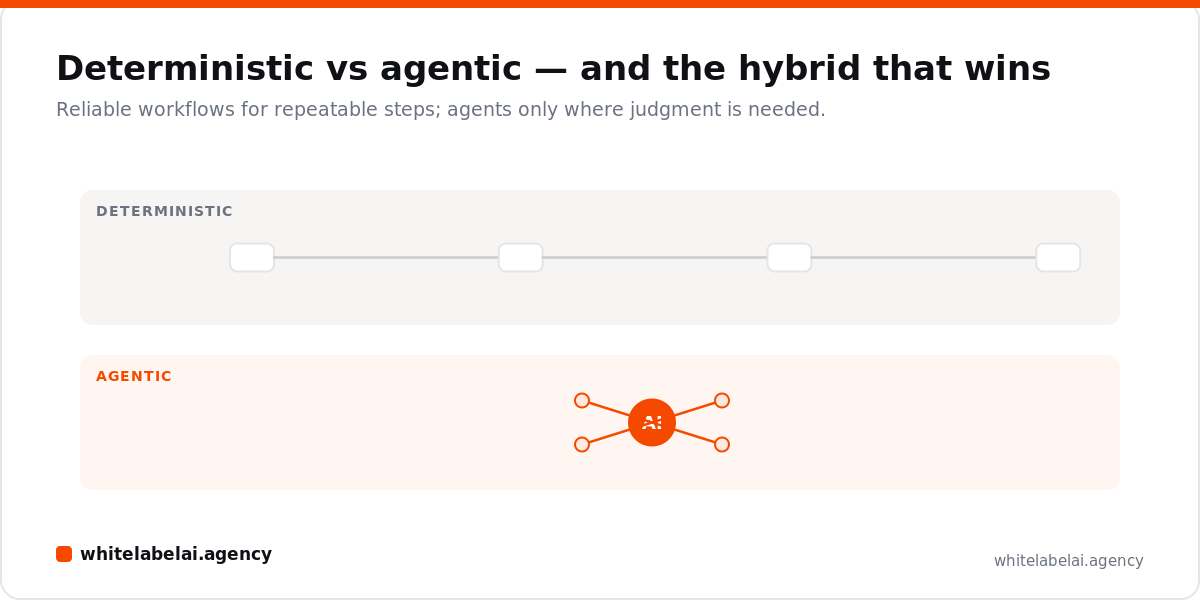
What “AI Agents vs Automation” Actually Means
Deterministic automation and agentic AI are not two flavors of the same thing. They are different tools built for different failure tolerances.
Deterministic automation is what n8n, Make, Zapier, and the RPA tools before them run. It executes a fixed sequence: if a form submits, do X, then Y, then Z. Feed it the same input twice and you get the same output twice. No reasoning happens. A trigger fires, a set of rules runs, and the workflow ends. This is what most agencies mean when they say “we automated it.”
Agentic AI is different by design. An agent is given a goal, a set of tools, and room to decide how to get there. It can read an unstructured input, decide what matters, choose which tool to call next, evaluate its own output, and try again if something looks wrong. deepset, an AI infrastructure company, frames it well: deterministic and agentic systems “exist on a spectrum, with neither inherently superior to the other.” The right choice depends on the use case, not the hype cycle.
The distinction that matters for agencies is reproducibility. A deterministic workflow that generates a weekly report will generate the identical report structure every single week. An agent asked to “summarize this client’s month” might phrase it differently each time, notice a different anomaly, or occasionally miss something a human would have caught. That’s not a bug. It’s what reasoning costs you.
Deterministic Automation: What It’s Good At (and Where It Breaks)
Deterministic automation wins on cost, speed, and auditability, and it loses the moment a task requires judgment. That trade-off is the entire reason it still runs most of the automation inside profitable agencies.
Where it’s strong: high-volume, well-defined processes. Client reporting pulled from ad platforms and dropped into a templated dashboard. Invoice data moving from your CRM to your accounting software. Scheduling, reminders, status updates, data syncs between tools you already use. These run in milliseconds, cost close to nothing per execution, and every step is visible in a log if something goes wrong. That auditability matters more than agencies usually admit. When a client asks why a report looked different last week, you want an answer that isn’t “the AI decided to.”
Where it breaks: anything with input variability the rules didn’t anticipate. A deterministic email-routing workflow works fine until a prospect writes a message that doesn’t match any of your keyword conditions, and it either misfires or does nothing. Teams patch this by adding more rules, and more rules, until the workflow becomes 300 conditional branches nobody fully understands. That ceiling is less a technology problem than a maintenance one.
We’ve written a full framework for what to automate first in an agency. Onboarding, sales qualification, and scope tracking consistently outrank content and reporting on actual revenue impact.
Agentic AI: What It’s Good At (and Where It Breaks)
Agents earn their cost when a task requires reading unstructured input and making a judgment call that can’t be reduced to a rule. Everywhere else, they’re an expensive way to get a less predictable result.
Where agents are strong: classification of messy inputs (is this support ticket urgent, billing, or technical?), extraction from unstructured documents (pull the key terms out of this contract), and generation that needs to synthesize context (draft a proposal from a 40-minute discovery call transcript). These are tasks where a human would read, think, and decide, not tasks where a human would follow a checklist. An agent can also self-correct mid-task. If its first attempt at reading a PDF fails, it can try OCR, and if that’s unclear, flag it for a human instead of silently producing a wrong answer.
Where agents fall short: cost and reliability at volume. Deterministic execution costs fractions of a cent and runs in milliseconds. Agentic execution involves LLM inference on every decision, which according to analysis compiled by The Thinking Company runs roughly $0.01 to $0.50 or more per execution depending on model and task complexity. That’s a 10 to 100x cost gap that only makes sense when the agent is doing something deterministic automation genuinely cannot do. Reliability is the bigger issue. Gartner reported in June 2025 that over 40% of agentic AI projects will be canceled by the end of 2027 due to “escalating costs, unclear business value or inadequate risk controls,” and specifically warned that “many use cases positioned as agentic today don’t require agentic implementations.” That’s not an anti-agent statement from a skeptic. It’s Gartner’s own analyst.
The research backs this up from a different angle. Forrester’s Q4 2025 State of Intelligent Automation review of 1,400 enterprise automation projects, cited in The Thinking Company’s 2026 workflow analysis, found that 62% of failed automation projects had used an agentic approach for a task deterministic workflows would have handled more reliably and at lower cost. RAND Corporation‘s research on AI project failure puts the broader number at over 80% of AI projects failing to deliver their intended business value, roughly double the failure rate of comparable non-AI IT projects. Agents aren’t broken. They’re frequently misapplied.
Side-by-Side Comparison: Deterministic Automation vs Agentic AI
| Dimension | Deterministic Automation (n8n, Make, Zapier) | Agentic AI |
|---|---|---|
| Execution pattern | Fixed sequence, same steps every run | Dynamic, agent decides steps and order |
| Output reproducibility | Identical output for identical input | Variable, LLM reasoning isn’t fully deterministic |
| Handles novel/unstructured input | Fails or hits a fallback path | Reasons through it, adapts |
| Self-correction | None, a broken step stays broken | Can retry, re-plan, or escalate |
| Auditability | Every path is pre-defined and reviewable | Partial, decisions are logged, not pre-defined |
| Cost per execution | Fractions of a cent to a few cents | Roughly $0.01 to $0.50+ depending on model and task |
| Speed | Milliseconds | Seconds to minutes |
| Failure mode | Silent wrong path or explicit error | Unexpected reasoning or hallucinated output |
| Best fit | High-volume, rule-based, compliance-sensitive tasks | Judgment calls: classification, extraction, generation |
The Hybrid Model That’s Winning in 2026
The practical answer to ai agents vs automation isn’t “pick one.” It’s building a deterministic backbone and dropping agents in at the two or three points in the workflow that actually require judgment.
Picture a lead intake workflow. A form submits. That’s a deterministic trigger. The system then needs to figure out whether this lead is a fit, what they’re asking for, and how urgent it is. That’s the reasoning step, and it’s where an agent belongs, reading the free-text field and classifying intent and priority. Once classified, everything downstream is deterministic again: route to the right pipeline stage, notify the right person, schedule the right follow-up sequence. One agent call, wrapped by automation on both sides.
This pattern has a name in enterprise circles: “intelligent RPA” or “AI-augmented automation,” where the overall workflow stays deterministic and agentic capability gets added to specific steps like document understanding or natural language classification. It’s described as one of the more practical entry points for organizations moving toward agentic systems, because it limits the blast radius of a bad AI decision to one narrow step instead of an entire process.
The reasoning is architectural, not just financial. If the whole workflow is one agent trying to decide everything, a bad decision at step 2 can cascade into step 3, 4, and 5 with no fixed point to catch it. If only step 2 is agentic and everything around it is deterministic, a bad classification gets caught by the guardrails on either side: a confidence threshold or a human review queue for anything the agent flags as uncertain. Our piece on building AI agents for agencies goes deeper on how orchestration and decision boundaries make this safe in production, and what an AI workflow actually is covers the layer between raw automation and full agent autonomy.
Decision Table: Which Approach for Which Agency Task
Use this as a starting filter. When you’re unsure, default to deterministic. You can always add an agent at a specific step later; unwinding an overbuilt agentic system afterward is harder.
| Agency task | Recommended approach | Why |
|---|---|---|
| Client reporting (pull, format, send) | Deterministic automation | Fixed schema, high frequency, zero judgment needed |
| Lead intake and routing | Hybrid: agent classifies, automation routes | Free-text intent varies; routing logic doesn’t |
| Proposal drafting from call notes | Agent, wrapped in a deterministic pipeline | Requires reading unstructured context and drafting language |
| Invoicing and data sync between tools | Deterministic automation | Structured fields, no interpretation required |
| Content QA against brand voice | Agent | Judgment call on tone, not a rule check |
| Support ticket triage | Hybrid: agent classifies, automation escalates | Category and urgency vary; escalation path is fixed |
| Campaign budget pacing alerts | Deterministic automation | Rule-based thresholds, needs millisecond reliability |
| Contract or scope document review | Agent | Reasoning about unusual clauses, not pattern matching |
| Meeting scheduling and reminders | Deterministic automation | Fully predictable, no reasoning involved |
| Client sentiment monitoring across channels | Hybrid: agent scores sentiment, automation alerts | Language interpretation feeds a fixed alert threshold |
For a broader map of agent types beyond this table, see the seven types of AI agents agencies should know and how to pick the right one per workflow.
n8n vs Make vs Zapier: Where They Actually Stand on Agents in 2026
The three biggest automation platforms have all added agentic features, but they haven’t converged into the same product. n8n leads on AI depth. Zapier leads on breadth and simplicity. Make sits in the middle.
n8n shipped n8n 2.0 in January 2026 with native LangChain integration and more than 70 AI-specific nodes covering models, memory, chains, and vector stores, according to n8n’s own product documentation. It bills per workflow execution rather than per step, which n8n’s pricing page states can cut costs substantially for multi-step workflows compared to per-task billing. A 10-step workflow running thousands of times a month is one execution count per run, not ten. That makes it the strongest fit for agencies with technical resources who want agents doing real work inside a workflow, not just a chat layer bolted on top.
Zapier built Zapier Agents on top of its existing catalog of 8,000+ connected apps, aimed at teams who want autonomous task execution without touching code. Its pricing model bills per task. Every action inside a Zap counts, so a ten-step Zap firing 1,000 times a month burns 10,000 billed tasks. It’s the fastest to get started with and the easiest for non-technical teams, at a real cost premium once volume climbs.
Make sits between the two. It introduced Maia, an AI assistant that builds automation scenarios from a plain-language description, and offers over 3,000 integrations on a per-operation, now credit-based, pricing model. Make’s agent-building capability is newer and less mature than n8n’s, but its visual builder remains one of the more approachable options for agencies without in-house developers.
None of the three has made agents the default. All three still treat deterministic workflow-building as the core product, with agentic features layered on top. That tracks with everything else in this article. The tools are following the same pattern agencies should follow: automation first, agents where they earn their cost.
The Honest Take: Most Agency Wins Are Still Deterministic
If you’ve read this far expecting a pitch for going all-in on agents, this is the part where that doesn’t happen.
Gartner’s own guidance on agentic AI is blunt: “start by using AI agents when decisions are needed, automation for routine workflows and assistants for simple retrieval.” That ordering isn’t accidental. In our own delivery work, the highest-ROI systems we build for agency partners are still workflow-first: a deterministic backbone doing 80 to 90% of the steps, with one or two agent calls doing the parts that genuinely need reasoning. The agencies that try to build “one AI agent that runs the business” consistently end up with something slower and less trusted by their own team than the boring automation it replaced.
This isn’t a hedge. It’s what over 40% of agentic AI project cancellations by 2027 and an 80%+ overall AI project failure rate are actually telling you. Ambition without architecture doesn’t ship. The agencies getting real value from AI in 2026 are the ones who automated the predictable 90% first, then added judgment only where judgment was missing.
Frequently Asked Questions
What is the difference between AI agents and automation?
Automation runs a fixed sequence of steps and produces the same output for the same input every time. AI agents reason about a goal, decide which steps to take, and adapt based on what they find, including self-correcting mid-task. Automation is predictable and cheap. Agents are flexible and more expensive per run.
When should an agency use AI agents instead of automation?
Use agents when a task requires reading unstructured input and making a judgment call a rule can’t capture, such as classifying intent, extracting terms from a document, or drafting content from context. If the task is repeatable and well-defined, deterministic automation is almost always the better, cheaper, more reliable choice.
Is n8n better than AI agents for agencies?
n8n isn’t a competitor to AI agents. It’s an orchestration platform that now includes native agent-building tools (n8n 2.0, LangChain integration, 70+ AI nodes). Most agencies use n8n as the deterministic backbone and call an AI agent as one node inside a larger n8n workflow, rather than choosing one over the other.
What is a hybrid AI workflow?
A hybrid AI workflow uses deterministic automation for the bulk of a process, including triggers, routing, and data movement, and inserts an AI agent at specific decision points, like classifying a message or extracting data from a document. This limits where non-deterministic reasoning can affect the outcome and is the pattern most production systems use in 2026.
Are AI agents reliable enough for client-facing agency work?
For narrow, well-scoped tasks with human review, yes. For fully autonomous client-facing decisions, not consistently. Gartner reports over 40% of agentic AI projects are expected to be canceled by the end of 2027 due to cost and reliability issues, largely from projects that gave agents more autonomy than the use case justified.
Do Zapier, Make, and n8n all support AI agents now?
Yes, but at different depths. n8n has the most native AI-agent tooling, including LangChain integration and 70+ AI nodes. Zapier offers Zapier Agents across its 8,000+ app catalog, aimed at non-technical teams. Make offers Maia, an AI assistant for building automations, with agent-building features that are newer and less developed than n8n’s.
How much more does an AI agent cost to run than automation?
Deterministic automation typically costs fractions of a cent per execution. Agentic execution runs roughly $0.01 to $0.50 or more per run depending on the model and task complexity, according to cost analysis from The Thinking Company. That’s a 10 to 100x premium that only makes sense when the task genuinely requires reasoning.
Should a small agency build AI agents or stick with automation?
Start with automation. Deterministic workflows are cheaper to build, easier to debug, and cover most of an agency’s repetitive work, from client reporting to onboarding to data sync. Add an agent only at the specific step where a workflow keeps breaking because it needs judgment, not before.
Not Sure Where the Line Is for Your Agency?
Every agency has a different mix of tasks that are genuinely rule-based and tasks that need judgment, and getting that split wrong is the difference between a system that runs itself and one that quietly breaks every few weeks. On a partner call, we’ll map your highest-friction workflows against this framework and show you exactly where automation should end and an agent should start.