
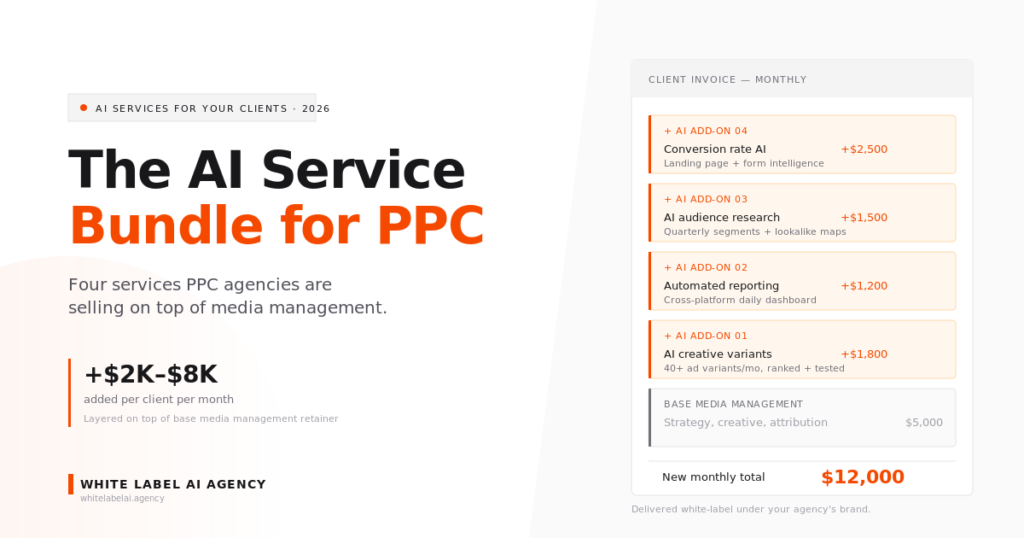
PPC agencies are layering AI services on top of media management to protect margin in 2026. The four most-bundled services are AI creative variants, automated reporting, AI audience research, and conversion rate AI. Charged separately, these add $2,000 to $8,000 per client per month at 60 to 75% gross margin with white-label delivery.
Why PPC agency margins are squeezed in 2026
This year is hard on PPC agencies. Google Performance Max and Meta Advantage+ are eating the manual optimization work that justified retainers for years. 75% of PPC professionals now use generative AI for ad creation, and 85% use automated bidding (Affinco State of PPC 2026). Meta is on track to overtake Google in global digital ad revenue for the first time, hitting $243B against Google’s $239B (eMarketer). The ad market is bigger than ever (global digital ad spend hit $1.32 trillion in 2026), but the work the platforms used to pay agencies to do is increasingly handled by the platforms themselves.
Your clients see this. They walk into renewals asking, “If Performance Max does the bidding, the targeting, the creative testing, why am I paying you 15% of spend?” That’s a fair question, and the agencies who don’t have a sharp answer are losing accounts.
The agencies winning right now aren’t fighting the platforms. They’re building service layers around the platforms: services that AI can’t deliver from inside a Google Ads or Meta Ads account, that the client genuinely needs, and that justify pricing increases instead of decreases. That’s the AI service bundle.
For a parallel argument on the SEO side of the same shift, see how SEO agencies are reframing AI services.
What “AI PPC services” actually means
AI PPC services is a productized offering an agency sells to clients on top of base media management. It includes AI-generated creative variants, automated cross-channel reporting, AI-powered audience research, and conversion rate AI deployed against the client’s funnel. The agency owns strategy, creative direction, and the client relationship. A white-label partner runs the AI tooling stack and the day-to-day execution.
This is not a replacement for the media-management retainer. It’s an addition. The base PPC management retainer continues for the work that still requires senior human judgment (strategy, creative briefs, brand voice, attribution interpretation, budget allocation across channels). The AI service bundle adds new line items the platforms can’t deliver on their own.
The deliverable the client sees:
- A weekly creative report (variants generated, tested, winners scaled)
- A unified cross-platform reporting dashboard refreshed daily
- Quarterly audience research deliverables (new segment recommendations, lookalike maps, intent signals)
- Conversion rate uplift tied to specific AI experiments
What the client never sees:
- The white-label partner running the AI creative engine, the ETL pipeline behind the dashboard, and the audience research tooling
- The integration layer between platforms (Google Ads, Meta Ads, LinkedIn Ads), the client’s CRM, and the reporting layer
- The QA layer that filters AI creative output before it reaches client review
That separation is what makes the bundle profitable.
The 4 AI services PPC agencies are bundling now
Every productized AI PPC bundle should include some combination of these four services. Pick the ones that match the client’s stack and budget.
1. AI creative variants at scale. AI generates ad copy and image variants from a brand brief, ranked by predicted performance, ready for human review. A typical engagement produces 20 to 60 variants per ad set per month vs the 4 to 8 a human team produces manually. Winners get scaled, losers get retired. The compounding effect comes from variant volume: more tests means faster learning, lower CPM, and incrementally better CTR over a quarter.
2. Automated cross-platform reporting. A unified dashboard that pulls Google Ads, Meta Ads, LinkedIn Ads, TikTok Ads, and the client’s CRM into one view, refreshed daily. White-labeled with the agency’s branding. Most agencies still build these reports manually each month, taking 8 to 16 hours of account-manager time per client that goes away when this runs automated.
3. AI audience research and segmentation. Quarterly research output: new audience segments, lookalike maps, intent signal mapping, competitor audience analysis. Tools like Audiense, GWI, and AI-powered enrichment platforms. The agency packages this as a quarterly strategic deliverable with named recommendations, not a raw data dump.
4. Conversion rate AI. AI-powered landing page optimization, dynamic content for paid traffic, form intelligence, post-click attribution modeling. This is the deliverable that closes the gap between paid traffic and pipeline. Most clients don’t have it; most agencies don’t sell it. The ones who do see double-digit lift in conversion rate within 60 to 90 days.
A complete AI PPC bundle uses all four. A starter bundle picks two (typically creative variants + reporting). The bundle expands as the client’s spend grows.
Where AI in PPC genuinely beats humans
Three places AI is unambiguously better than a human PPC manager in 2026:
Bid optimization at scale. Real-time bid adjustments across thousands of keyword/audience combinations. No human makes 800 bid decisions per hour with consistent quality. Performance Max and Advantage+ are now the right answer for most accounts, and arguing otherwise is fighting the math.
Creative variant generation. Producing 40 ad variants from a brief takes AI 8 minutes. It takes a junior copywriter 3 to 5 hours. The volume difference compounds across testing cycles.
Cross-platform data unification. Pulling Google Ads + Meta Ads + LinkedIn Ads + CRM data into a single live dashboard is a problem AI tooling solves cleanly. Manual reporting is the work no client wants to pay for and no account manager wants to do.
Where AI in PPC still doesn’t beat humans (the honest take)
This is the section that earns trust with skeptical PPC agency owners. AI doesn’t replace strategy. It amplifies whatever foundation already exists. If the strategy is wrong, AI scales the wrong strategy faster.
Four places humans still beat AI in 2026:
Brand context and creative judgment. AI can generate 60 ad variants. AI cannot tell which variants are off-brand, which subtle word choice creates legal risk, or which creative direction aligns with the client’s broader marketing narrative. That layer is human, and it’s where senior PPC managers still earn their keep.
New product launches and sudden campaigns. AI bidding algorithms need 2 to 6 weeks of conversion data to optimize well. New products, time-limited promotions, and crisis-response campaigns don’t have that data. Manual campaign structure plus smart layering is still the right answer for the first 30 days. 43% of PPC managers in 2026 specifically criticize the lack of granular control AI campaign types like Performance Max give them (Affinco State of PPC 2026), and that critique is correct.
Attribution interpretation. AI gives you the numbers. AI doesn’t tell you whether the lift in conversion you’re seeing is real, seasonal, fraudulent, or attributable to a different campaign entirely. That judgment requires understanding the client’s business, the competitive landscape, and historical context the AI doesn’t have.
Strategic budget reallocation. Moving budget from Google Search to Meta Reels because the client’s ICP shifted, or pulling spend from a brand campaign to fund a competitive launch, requires understanding the client’s quarterly priorities and risk tolerance. AI can flag the data signal. The decision is human.
This calibration is what separates the agencies winning AI PPC engagements from the agencies losing them. Selling AI PPC services without this honesty is how you lose the renewal in month 7 when the client realizes the AI overhyping.
Pricing: what to charge clients
Pricing benchmarks for AI PPC services bundled on top of base media management (sourced from Affinco State of PPC 2026, ALM Corp 2026 PPC pricing guide, Get Ryze 2026 value-based pricing analysis):
| Tier | Bundle scope | Monthly add-on price | Wholesale delivery cost | Agency margin |
|---|---|---|---|---|
| Starter | 2 services (creative + reporting) | $1,500–$3,000 | $400–$900 | 65–75% |
| Growth | 3 services (+ audience research) | $3,000–$6,000 | $900–$1,800 | 60–72% |
| Premium | All 4 services (+ conversion AI) | $6,000–$12,000+ | $1,800–$4,000 | 55–65% |
A few pricing rules that hold:
Don’t bundle AI services into the base media management retainer at no charge. This is the single biggest mistake PPC agencies are making in 2026. Free is what kills perceived value. If you’re already managing the client’s $50K monthly Google Ads spend at 12% management fee, add the AI bundle as a separate $4,000 line item. The client signs both because the value is named and priced individually.
Move off pure percentage-of-spend pricing where possible. Value-based pricing approaches yield 40 to 60% higher profit margins than percentage-of-spend models (Get Ryze 2026 analysis). The cleanest structure for the AI bundle is a flat monthly fee tied to the deliverable scope, not the client’s media spend.
Charge a setup fee. $2,500 to $7,500 covers brand brief development, creative system setup, dashboard build, and integration mapping. Setup fees fund the upfront work and signal value.
For more on agency pricing structures, how to price AI services for agencies covers the structural decisions.
Build, buy, or white-label: the agency decision
| Build in-house | Buy a tool stack | White-label delivery | |
|---|---|---|---|
| Time to first client live | 4–8 months | 2–3 months | 30 days |
| Upfront investment | $40K–$120K | $10K–$30K | $0 |
| Ongoing cost | Specialists + tooling ($150K+/yr) | License fees + ops time | $400–$4,000/client/mo |
| Capacity ceiling | Limited by team | Limited by ops | Scales with client base |
| Risk if it doesn’t work | Sunk cost | License lock-in | Cancel in 30 days |
For PPC agencies of 5 to 50 people in 2026, white-label is the cleanest path. The build-in-house option only makes sense if AI PPC will be a core long-term service line and the agency has 50+ people to absorb the specialist hires.
Common mistakes PPC agencies make selling AI services
Four patterns we see repeatedly:
Bundling AI services into the base retainer for free. Already covered in pricing, but this deserves repetition. Free signals to the client that the AI services aren’t worth paying for. Then renewal time comes and the client cuts the retainer “because AI does most of it now.” Always price AI services as separate line items.
Overpromising on what AI does in PPC. The agencies losing renewals are the ones who told the client AI would replace 50% of the manual work and then couldn’t deliver. Calibrate. Tell the client where AI wins (bid optimization, creative variants, reporting) and where humans still win (strategy, creative judgment, attribution). Honesty earns trust; trust gets the renewal.
Skipping the brand brief layer. AI creative variants are only as good as the brand brief they’re generated from. Vague brief = generic ads = client unhappy. Spend the first 14 days getting the brand brief, voice document, and creative system right before scaling variant generation.
Treating AI PPC services as a one-time setup. AI tooling needs ongoing maintenance: prompt iteration, creative refresh, audience model retraining, dashboard updates. Pricing must reflect that. If you’re scoping AI PPC as a 90-day engagement, you’ve miscoded the offer.
Internal-use bonus paragraph: the agencies that sell AI PPC services to clients almost always run the same stack for their own paid acquisition. Your demo bookings, retention campaigns, and inbound paid spend run on the same creative, reporting, and audience research infrastructure you’re delivering to clients. Building AI fluency on your own ad accounts before scaling client engagements is good operational hygiene and, frankly, decent marketing.
Frequently asked questions
What’s the difference between using AI tools internally and selling AI PPC services?
Using AI tools internally means your team uses ChatGPT, Performance Max, or creative AI to do PPC work faster. The client never sees it as a separate offering. Selling AI PPC services means productizing the deliverables (creative variants, automated reporting, audience research, conversion rate AI) as a named bundle on the client’s invoice with separate pricing. The first is internal efficiency. The second is a revenue play.
Won’t clients argue Performance Max already does most of the AI work?
Yes, and they’re partially right. Performance Max handles bidding and asset rotation. It does not handle creative variant generation at scale, cross-platform reporting unification, audience research, or conversion rate optimization on the client’s funnel. The AI service bundle is what AI can’t do from inside a single ad platform.
How much creative volume should an AI PPC bundle produce per month?
Industry benchmarks for 2026 sit at 20 to 60 ad creative variants per ad set per month, depending on platform and budget. Lower volumes work for niche clients. Higher volumes work for performance-focused accounts running aggressive testing cycles. Quality control via human editorial review is non-negotiable; volume without QA produces brand drift and platform policy violations.
Should AI PPC services replace the base media management retainer?
No. Layer it. Base media management continues for strategy, creative direction, attribution interpretation, and the human judgment work AI doesn’t do well. The AI service bundle adds new revenue on top. Most successful 2026 engagements look like a $4K base media retainer + $4K AI service bundle = $8K combined monthly revenue, vs the $4K-only retainer most agencies still sell.
What if the client only wants one or two AI services, not the full bundle?
That’s fine. Start with the Starter tier (creative variants + reporting are the easiest sales). The other two services usually get added in months 4 to 8 once the first two prove ROI. Don’t force the full bundle on a client who isn’t ready.
How is success measured for AI PPC services?
Five core metrics monthly: creative test velocity (variants generated, tested, scaled), reporting time saved (hours of account-manager time before vs after), audience expansion impact (new segments performing above benchmark), conversion rate uplift, and total revenue from AI services as a percentage of the client account. The reporting layer is what justifies the renewal six months in.
Can agencies sell AI PPC services without an in-house creative team?
Yes, with white-label delivery. The partner runs the AI creative engine, the reporting infrastructure, and the audience research tooling. The agency contributes brand brief, creative direction, and the client relationship. For agencies under 50 people, this is almost always more economical than hiring AI ad ops specialists.
How does AI PPC interact with AI search visibility (AEO/GEO)?
Increasingly tightly. As AI Overviews capture more search query volume, paid search budgets are shifting toward platforms with stronger AI integration (Meta, AI-native ad networks). Conversion rate AI on the post-click side becomes more important when paid traffic volume is harder to grow. For deeper context on the search-side shift, see our companion post on GEO for agencies.
Ready to add AI PPC services to your agency’s bundle?
Your client just asked why they’re paying you when Performance Max does most of the work. The agencies winning that conversation are the ones with a sharp answer: “You’re paying us for the four things Performance Max can’t do — and here’s the bundle.”
If you’d rather not spend 4 to 8 months building the AI creative engine, reporting infrastructure, and audience research stack internally, white-label delivery has you live with your first client engagement inside 30 days, with the technical execution handled under your agency’s brand.
We’ll walk through how white-label AI PPC delivery runs, what the four-service bundle actually looks like, and how to position it to your existing client base. No slide deck, no sales pressure. Just a working session.