
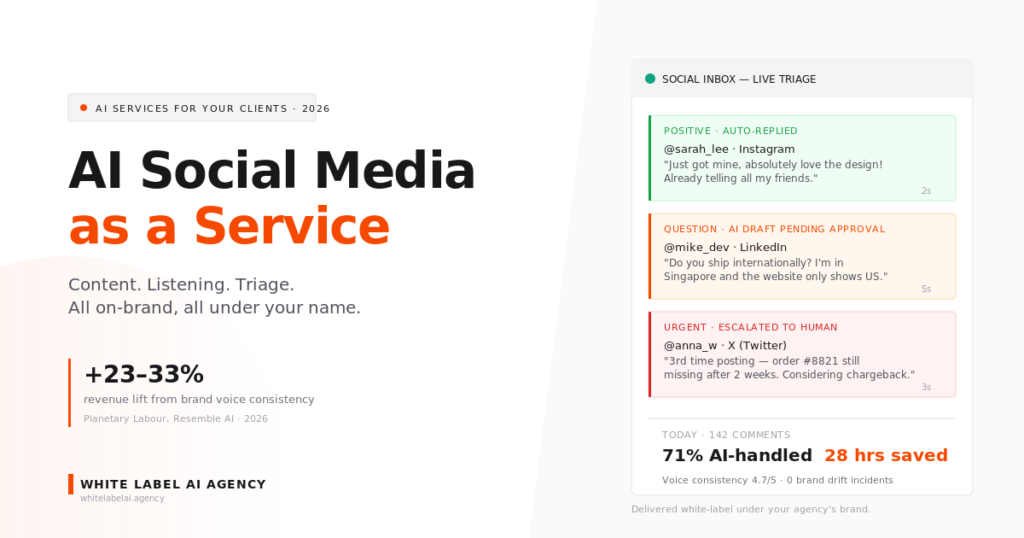
White-label AI social media services let agencies sell a full social ops layer to clients in 2026. Productized AI content, listening, comment triage, paid social, and reporting (delivered with brand voice consistency at scale) charge $3,000 to $10,000 per client monthly at 60 to 75% gross margin through white-label delivery.
The brand voice problem every social agency owner is scared to discuss
Before we get to packaging or pricing, address the thing your clients actually care about. Companies that achieve consistent brand voice across channels see 23 to 33% revenue increases (Planetary Labour 2026, Resemble AI 2026). Inconsistent brands pay significantly higher media costs to achieve the same growth. Your clients aren’t paying for posts. They’re paying for consistency: the same voice, the same vocabulary, the same emotional register across 200+ pieces of monthly social content.
Most social agencies trying to scale with AI in 2026 hit this wall: AI ships volume, voice drifts, client gets unhappy, renewal stalls. The agencies winning have figured out the brand voice layer first and then scaled volume. Skip that order and the engagement dies in 90 days.
This post is structured around that constraint. Every service component below assumes the brand voice document exists, the editorial workflow protects it, and the AI tooling is trained on it. If those three pieces are absent, AI social media services don’t work as a productized offering. They work as cheap content production that erodes the agency’s reputation.
For deeper context on the brand voice document and editorial layer, see selling AI content production to clients, which covers the same architecture.
Why social agencies are losing engagements in 2026
The economics shifted. The global social media management market hit $36.42 billion in 2026, up from $29.93B in 2025 (Skyquest), with the AI-specific segment at $5.65 billion and growing at a 37.11% CAGR (MarketsandMarkets). 85% of marketers now use AI content tools. The output volume is up. The cost-to-produce is down.
Your clients see this. They’re hiring in-house social leads. They’re using ChatGPT and Claude to write captions. They’re asking why the social retainer hasn’t dropped. Some of them have already canceled. Others are negotiating you down or shifting to project work.
The agencies winning are doing two things. They’re expanding the service from “post creation” (which is now table stakes) to “social ops” (which clients can’t easily DIY). And they’re protecting the brand voice layer relentlessly, because that’s the only deliverable a client genuinely cannot replicate themselves.
What “AI social media services” actually means
AI social media services is a productized agency offering that includes content production, social listening, comment triage and community management, paid social AI, and unified performance reporting, all delivered with a brand voice document and editorial layer that maintains consistency at scale. The agency owns strategy, voice guidelines, and the client relationship. A white-label partner runs the AI tooling stack and the day-to-day execution.
The deliverable is a system, not a posting calendar. The client doesn’t hire you for 30 Instagram posts. They hire you for a social presence that’s consistent, responsive, performance-tracked, and on-brand across every touch.
The deliverable the client sees:
- A monthly content calendar mapped to their funnel
- Published content (organic posts, stories, reels, ads) on schedule, on brand
- AI-handled comment triage with human handoff for escalations
- Quarterly listening report (sentiment, share-of-voice, competitor signals)
- A unified monthly performance dashboard
What the client never sees:
- The white-label partner running content production, listening, and triage tooling
- The brand voice document being trained into the AI stack
- The editorial QA layer between AI draft and publication
The 5 AI services social agencies are productizing
A complete AI social media bundle uses all five components. A starter bundle picks two or three.
1. AI content production at scale. Caption generation, image creation, short-form video editing, story copy, ad copy. Trained on the client’s brand voice document and editorial guidelines. Volume: 60 to 200+ pieces per month per client across platforms. Hootsuite OwlyWriter and platforms like Typeface, Buffer, and Eclincher cover most of this layer.
2. Social listening and sentiment monitoring. Brand mention tracking, competitor signal detection, sentiment analysis, trend identification. Output: a quarterly listening report and monthly sentiment summary. Tools: Sprinklr, Brandwatch, Meltwater, plus AI summarization on top.
3. Comment triage and community management. AI classifies incoming comments and DMs by urgency and sentiment, drafts responses for human approval on routine queries, and escalates anything sensitive or high-value to the agency’s account manager. Industry benchmarks put well-implemented triage at 60 to 80% deflection of routine comments to AI-handled responses, freeing 20 to 40 hours of community manager time per client per month.
4. Paid social AI. Campaign builds, AI creative variants, automated reporting, audience research, conversion rate AI on the post-click side. This is the same bundle covered in our AI PPC services post, scoped specifically to social platforms (Meta, LinkedIn, TikTok, Pinterest).
5. Unified performance reporting. Cross-platform dashboard refreshed daily, monthly client report with attribution analysis, quarterly strategy review. Replaces the manual reporting work that consumes 8 to 16 hours per client per month.
Pricing: what to charge clients
Pricing benchmarks for AI social media services in 2026 (sourced from ALM Corp 2026 social pricing guide, Eclincher 2026 pricing rates, Apaya 2026 social cost analysis):
| Tier | Scope | Monthly client price | Wholesale delivery cost | Agency margin |
|---|---|---|---|---|
| Starter | 2–3 platforms, 30–60 pieces, basic triage | $2,000–$4,000 | $500–$1,200 | 65–75% |
| Growth | 3–5 platforms, 60–120 pieces, full triage + listening | $4,000–$8,000 | $1,200–$3,000 | 60–72% |
| Premium | All channels, unlimited posts, AI community management, paid social bundle | $8,000–$15,000+ | $3,000–$5,500 | 55–65% |
A few pricing rules that hold:
Lead with brand voice, not volume. When clients ask why your retainer is $5,000 when ChatGPT is free, the answer is the brand voice document, the editorial layer, and the consistency at scale. Volume is the easy part. Voice is the hard part.
Charge a structured setup fee. $2,000 to $5,000 covers brand voice document development, social style guide, listening configuration, triage rule setup, and platform integrations. Skipping the setup fee teaches the client that the strategic work is free, which kills margin on every renewal.
Don’t price per post. Per-post pricing is the model AI commoditized in 2026. Tiered retainers tied to volume bands and channel coverage are cleaner.
For more on layered pricing for agency AI services, see how to price AI services for agencies.
Build, buy, or white-label: the agency decision
| Build in-house | Buy a tool stack | White-label delivery | |
|---|---|---|---|
| Time to first client live | 3–6 months | 1–2 months | 30 days |
| Upfront investment | $30K–$80K | $5K–$20K | $0 |
| Ongoing cost | Editor + tooling ($120K+/yr) | License fees + ops time | $500–$5,500/client/mo |
| Brand voice protection | Hands-on, fragile when team changes | Limited (tool features only) | Embedded in delivery process |
| Capacity ceiling | Limited by team | Limited by ops | Scales with client base |
For social agencies of 5 to 50 people in 2026, white-labeling is the cleanest path. The “buy a tool stack” route fails for most agencies because brand voice consistency is process-driven, not tool-driven, and DIY tool operations consume more ops time than agencies budget for.
Common mistakes social agencies make selling AI services
Four patterns we see repeatedly:
Skipping the brand voice document. This is the single biggest mistake in 2026. Agencies that scale AI social production without a documented brand voice generate generic content that drifts off-brand within 60 days. The client notices, the team complains, the renewal dies. Spend the first 14 days getting the voice document right before any volume scaling.
Selling volume, not consistency. “We’ll ship 200 pieces of social content per month” is a volume pitch. “We’ll maintain brand voice consistency across 200 pieces of monthly content with daily approvals and a quarterly voice audit” is a consistency pitch. Same delivery, completely different proposal. Consistency converts and retains.
Underpricing because AI feels cheap. Wholesale delivery costs $500 to $5,500 per client per month. The instinct to price at $2,500 because “that’s only 2x our cost” kills margin. Hold pricing at $4,000 to $8,000 for substantial programs because that’s what the client’s outcome (engagement growth, brand authority, lead generation) is worth, not what the work costs.
Treating community management as set-and-forget. AI triage is the easy half. The hard half is the human escalation rules, the response approval workflow, and the crisis protocol. Agencies that automate triage without building those layers get caught when something sensitive goes live unreviewed.
Internal-use bonus paragraph: the agencies that sell AI social media services to clients almost always run the same workflow on their own social channels. Your agency’s LinkedIn, Twitter/X, and Instagram presence runs on the system you’re delivering. The compounding benefit is real: better voice consistency on your own social makes you a better seller of the service.
Frequently asked questions
How do agencies maintain brand voice consistency across AI-generated content?
Three components: a documented brand voice guide (vocabulary, sentence rhythm, tone calibration, prohibited phrases), AI tooling trained or prompted with that guide as context, and a human editorial review layer that catches drift before publishing. Tools like Claude Projects, Typeface, and Jasper handle the training side. The editorial review is what most agencies underinvest in.
What’s a realistic content volume per client per month with AI workflows?
For comprehensive programs: 60 to 200 pieces per month across 3 to 5 platforms. AI-enabled workflows produce roughly 60 to 70% of routine content; humans handle thought leadership, sensitive responses, and creative direction. Smaller engagements run 30 to 60 pieces focused on one or two priority channels.
How does AI handle comment triage and community management?
AI classifies incoming comments and DMs by urgency and sentiment, drafts responses for routine queries (FAQs, thank-yous, basic product questions), and escalates sensitive or high-value interactions to a human community manager. Industry benchmarks in 2026 put well-implemented triage at 60 to 80% AI deflection on routine comments. The human still owns crisis response, brand-sensitive moments, and high-value influencer interactions.
Should AI social media services replace traditional social media management?
No. Layer it. Traditional social management retainers continue for strategy, creative direction, and high-value relationship work. AI services add new revenue lines on top: scaled content production, listening, AI triage, paid social AI. Most successful 2026 engagements look like a $3K base social retainer plus a $4K AI services bundle equals $7K combined monthly revenue, vs the $3K-only retainer most agencies still sell.
How is success measured for AI social media services?
Six core metrics: content volume produced, brand voice consistency score (5-point editorial rubric), engagement rate trend, sentiment shift, comment response time, and conversion contribution. The reporting layer is what justifies the renewal six months in. Clients who only see post counts get bored; clients who see voice consistency scores and sentiment trends renew.
Can agencies offer AI social media without an in-house creative team?
Yes, with white-label delivery. The partner handles content production, listening, triage, and reporting tooling. The agency contributes brand voice strategy, editorial direction, and the client relationship. For agencies that don’t yet have AI-native social production capability, partnering is faster than hiring.
What about platform-specific limitations on AI content?
Most major platforms (Meta, LinkedIn, TikTok, X, Pinterest) allow AI-generated content as long as it’s transparent and complies with platform policies. The risk areas are deepfakes, impersonation, and undisclosed AI in regulated verticals (health, finance). Agencies should embed compliance checks into the editorial layer.
How do AI social services interact with paid social?
Tightly. Organic AI content production feeds paid social creative. Paid social AI builds on the same brand voice document and creative library. The two services compound: better organic content informs better paid creative; better paid performance funds more organic investment. Most premium tier engagements bundle the two.
Ready to add AI social media services to your agency’s offering?
Your clients are spending on social right now. Some are doing it badly. Some are paying for traditional social management and watching engagement decline. Some are using ChatGPT internally and producing generic content that erodes their brand. Each of those is a client engagement waiting to happen, with the right service offering.
If you’d rather not spend 3 to 6 months building AI social media production, listening, and triage capability internally, white-label delivery has you live with your first client engagement inside 30 days, with the brand voice layer and editorial workflow handled under your agency’s brand.
We’ll walk through how white-label AI social media delivery runs, what the bundle looks like, and how to introduce the service to your existing client base. No slide deck, no sales pressure. Just a working session.