
Yes. Agencies can sell AI email marketing services for agencies as a standalone or bundled offer by packaging segmentation, AI copy generation, subject-line and send-time optimization, lifecycle flows, deliverability management, and reporting into one retainer. Delivered through a white-label partner, the bundle runs at 55-70% gross margin without hiring an in-house email specialist.
What “AI email marketing services” actually means
AI email marketing services is a productized offering where the agency owns strategy, brand voice, and the client relationship, while AI tooling handles segmentation, copy drafting, send-time decisions, and reporting underneath. It is not “we typed a prompt into ChatGPT and hit send.”
That distinction matters because most clients have already tried the DIY version. They have a Klaviyo or Mailchimp account, they’ve poked at the AI subject-line button, and they’re underwhelmed. What they haven’t experienced is email run as a system: segmentation that splits behavior from demographics, a lifecycle map covering the full customer journey, and a deliverability practice that protects sender reputation while volume scales.
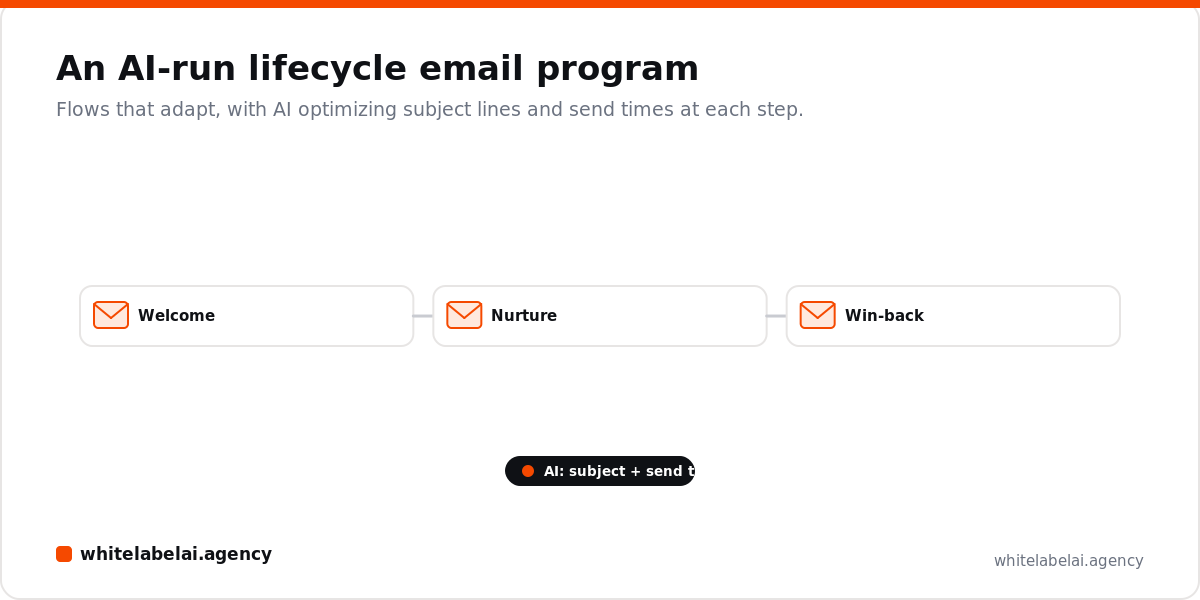
What the client sees: a content calendar, a live set of lifecycle flows (welcome, nurture, abandoned cart, win-back), and a monthly dashboard of revenue per email, list health, and flow performance.
What the client never sees: the AI copy pipeline trained on their brand voice document, the authentication and warmup behind the sending domain, and the editorial QA layer that catches generic output before it goes out.
The six components of a sellable AI email bundle
A full bundle includes six pieces. Smaller engagements start with two or three and expand.
1. Segmentation and audience intelligence. AI-driven segments built on behavior (browse history, purchase recency, engagement decay) rather than static lists. Klaviyo’s K:AI platform now includes predictive analytics for next-order timing, lifetime value, and churn risk, feeding segments automatically.
2. AI copy generation trained on brand voice. Subject lines, preview text, body copy, and product recommendation blocks, drafted from a brand voice document and reviewed by a human editor before send. This is the same architecture covered in selling AI content production to clients. The model differs by channel; the guardrail is identical.
3. Subject-line and send-time optimization. According to The Pedowitz Group’s 2026 testing of HubSpot’s AI subject-line tool, AI-generated subject line variants tested against manually written ones lifted open rates 8 to 15% on average. Most major platforms build this in now: Klaviyo’s smart send time works at the individual subscriber level, Mailchimp’s Intuit Assist analyzes engagement history to pick send day and time, and ActiveCampaign’s Predictive Sending does the same inside its automation builder.
4. Lifecycle flow architecture. Welcome series, nurture sequences, abandoned cart and browse recovery, win-back campaigns, and post-purchase flows. According to Klaviyo’s 2026 benchmark report (183,000+ brands analyzed), automated flows deliver 3x higher click rates than one-off campaigns (5.58% vs. 1.69%) and 13x higher placed-order rates. Flows generated nearly 41% of total email revenue from just 5.3% of total sends. Campaigns are visible; flows are where the money is.
5. Deliverability management. Domain authentication, warmup, list hygiene, and complaint-rate monitoring. Covered in detail below because this is where AI email bundles most often go wrong.
6. Reporting. A monthly dashboard covering revenue per email, flow performance, list health, and deliverability, translated into plain-language recommendations rather than a raw metrics dump.
What the ROI numbers actually support
Email remains the highest-ROI channel agencies can pitch, and the number is more defensible than most marketing stats. According to Omnisend’s 2026 email marketing ROI benchmarks (citing data from Litmus and the DMA), the industry-average return is $36 to $42 for every $1 spent, rising to roughly $45 for ecommerce specifically. That beats paid search and paid social by a wide margin.
Two things to be honest about when you use this number. It’s an average across a wide range of list quality and sending practice, so a poorly run list won’t hit it. And platform-specific figures (Omnisend cites $79 for its own paid-plan merchants) reflect that platform’s customer base, not the industry at large. Use $36-$42 as the credible floor, not the ceiling.
The brand-voice guardrail: why generic AI email kills the retainer
A documented brand voice guide has to exist before AI touches a single subject line. Skip it and the copy drifts generic within a few sends, the client notices, and the renewal conversation gets harder.
The fix is the same one that works for white-label AI social media services: a written voice document, AI tooling trained against it, and a human editorial pass before anything sends. Customer.io’s AI now pulls brand colors and tone into generated content automatically, and Mailchimp’s Creative Assistant builds from a stored brand kit. The tooling has caught up. Maintaining the document is still the agency’s job.
The deliverability guardrail: how AI email actually tanks sender reputation
This is the part most agencies skip, and the part that determines whether the service line survives past month three.
Start with the fact that matters most: AI-generated content is not, by itself, what gets flagged. According to Validity, an email deliverability platform, there is no evidence AI-written email is more likely to be marked as spam than human-written email. What damages sender reputation is generic, near-identical copy sent in volume from a domain with no authentication and no sending history. AI makes that pattern easier to produce at scale if nobody is watching.
Since February 1, 2024, Google’s bulk sender guidelines have required senders pushing 5,000+ messages a day to Gmail to authenticate with SPF, DKIM, and DMARC, use TLS, keep spam complaint rates below 0.30% (Google recommends staying under 0.10%), and support one-click unsubscribe. Yahoo mirrors these rules. Enforcement tightened further in November 2025: non-compliant traffic now gets permanently rejected with 550 errors instead of filtered to spam. The email simply never arrives.
The guardrails to run before scaling AI-generated volume:
- Authenticate first. SPF, DKIM, and DMARC configured and passing alignment, not just installed.
- Warm up new sending domains and IPs. Ramp volume gradually rather than launching a client’s full list on day one.
- Keep complaint rates under 0.10%, monitored via Google Postmaster Tools and the platform’s own deliverability dashboard.
- Enforce one-click unsubscribe (RFC 8058) on every marketing send.
- Clean the list before scaling volume. Suppress hard bounces and chronically unengaged addresses; a dirty list turns AI-generated volume into a reputation problem fast.
Treat deliverability as a line item in the retainer, not a background assumption. Agencies that skip this step are the ones asking, six months later, why open rates collapsed.
Pricing and margins: what to charge
Agency retainer pricing for email and lifecycle marketing services runs roughly $1,000 to $10,000+ per month depending on scope, list size, and send volume, based on published 2026 agency rate cards. Klaviyo-focused agencies tend to price in three bands: starter ($3,000-$5,000) for flow setup and campaign management, mid-tier ($5,000-$8,000) adding segmentation strategy and testing, and full-service ($8,000-$10,000+) for lifecycle strategy and cross-channel orchestration.
| Tier | Scope | Monthly client price | Wholesale delivery cost | Agency margin |
|---|---|---|---|---|
| Starter | Welcome + abandoned cart flows, 2-4 campaigns/month, basic segmentation | $1,500-$3,000 | $400-$900 | 65-73% |
| Growth | Full lifecycle flows, weekly campaigns, AI copy + subject-line testing, deliverability monitoring | $3,000-$6,000 | $900-$2,000 | 62-70% |
| Premium | Full lifecycle + predictive segmentation, cross-channel (email + SMS), dedicated deliverability management, monthly strategy review | $6,000-$12,000+ | $2,000-$4,000 | 55-67% |
A structured setup fee ($1,500-$4,000) covering brand voice document, flow architecture, platform configuration, and authentication setup protects margin on renewal. Skip it and the client assumes the strategic groundwork was free. For the underlying pricing logic, see how to price AI services for agencies.
Build, buy, or white-label: the delivery decision
Three paths get an agency to a live AI email service: hire and train in-house, buy a tool stack and run it yourself, or route delivery through a white-label partner. Each trades speed against upfront cost differently.
| Build in-house | Buy a tool stack | White-label delivery | |
|---|---|---|---|
| Time to first client live | 2-4 months | 3-6 weeks | 2-4 weeks |
| Upfront investment | $15K-$40K (hire + training) | $3K-$15K (platform + setup) | $0 |
| Deliverability expertise required | Hire or train it | Learn it under deadline pressure | Embedded in delivery |
| Brand voice protection | Hands-on, fragile when staff turns over | Limited to platform features | Built into the editorial process |
| Capacity ceiling | Limited by headcount | Limited by ops time | Scales with client base |
For agencies without an existing email specialist, white-label delivery is the fastest path to a live engagement without carrying the deliverability risk in-house. The warmup, authentication, and complaint monitoring above become someone else’s job to get right.
Where email fits in your service stack
Email is rarely sold alone. Agencies already running content production or social media services already have the brand voice document and editorial workflow built, so email slots in as an add-on, not a new discipline. A client paying $4,000/month for AI content production is a far easier upsell to a $3,000/month email retainer than a cold pitch. If you haven’t mapped the sequencing, AI services for agencies: what to offer covers it. Email tends to sit in the second wave, after content and social prove the workflow and before more technical builds like AI agents.
Common mistakes agencies make selling this
Skipping the deliverability setup. Launching AI-generated volume on an unauthenticated or unwarmed domain is the fastest way to lose a client’s entire list to the spam folder inside a month.
Pricing per email or per campaign. Per-send pricing is what AI commoditized. Tiered retainers tied to scope hold margin better.
No brand voice document before scaling volume. The single most common reason renewals stall at month three.
Treating reporting as an afterthought. A dashboard that only shows open rate gets ignored. One that shows revenue per email and deliverability health gets read every month.
Frequently Asked Questions
What is included in an AI email marketing service for agencies?
A full bundle covers six components: AI-driven segmentation, brand-voice-trained copy generation, subject-line and send-time optimization, lifecycle flow architecture, deliverability management, and monthly reporting. Smaller engagements start with two or three and expand as the client sees results.
How much should agencies charge for AI email marketing services?
Retainers typically run $1,500 to $12,000+ per month depending on scope, with most agencies landing in the $3,000-$6,000 range for a full lifecycle bundle. Add a $1,500-$4,000 setup fee for brand voice documentation and authentication configuration.
Does AI-generated email hurt deliverability or sender reputation?
Not by itself. According to Validity, spam filters do not penalize content for being AI-written. What damages sender reputation is generic, near-identical copy sent in high volume from a poorly authenticated domain, a failure mode AI can accelerate but doesn’t create on its own.
Can AI write email copy that still sounds like the client’s brand?
Yes, when it’s trained against a documented brand voice guide and reviewed by a human editor before send. Skip the voice document and AI copy drifts generic within a handful of sends.
What’s the difference between AI email marketing and traditional email marketing services?
Traditional email services rely on manual segmentation, human-written copy, and fixed send schedules. AI email marketing services add predictive segmentation, human-reviewed AI copy drafting, and individualized send-time optimization on top of the same lifecycle flow strategy.
Which AI email marketing platform should agencies use?
It depends on the client’s stack. Klaviyo leads for ecommerce-heavy clients on predictive analytics and flow depth. HubSpot suits clients already on its CRM. Mailchimp’s Intuit Assist is a lower-cost entry point for smaller lists. ActiveCampaign and Customer.io both offer strong AI agent features for B2B and lifecycle-heavy use cases.
Should agencies build AI email delivery in-house or use a white-label partner?
White-label delivery gets a client live in 2-4 weeks versus 2-4 months to hire and train in-house, and it puts deliverability expertise in the hands of a partner instead of a team learning it under deadline pressure.
How is success measured for an AI email marketing service line?
Five metrics matter most: revenue per email, flow performance against published platform benchmarks, list growth versus decay, deliverability health, and the split between flow revenue and campaign revenue. Flows should be doing most of the work: Klaviyo’s 2026 data shows flows generating roughly 41% of email revenue from just 5.3% of sends.
Ready to add AI email marketing to your agency’s offering?
Your clients are already spending on email. Most are underusing it: generic copy, no lifecycle flows beyond a welcome series, a deliverability setup nobody has checked since the account was created. Each one is a service conversation waiting to happen.
If you’d rather not spend months building segmentation, AI copy, and deliverability management in-house, white-label delivery gets your first client live in weeks, with the brand voice and deliverability guardrails handled under your agency’s brand.
We’ll walk through what the bundle looks like, how to price it against your existing retainers, and how to introduce it to clients already paying you for content or social.