
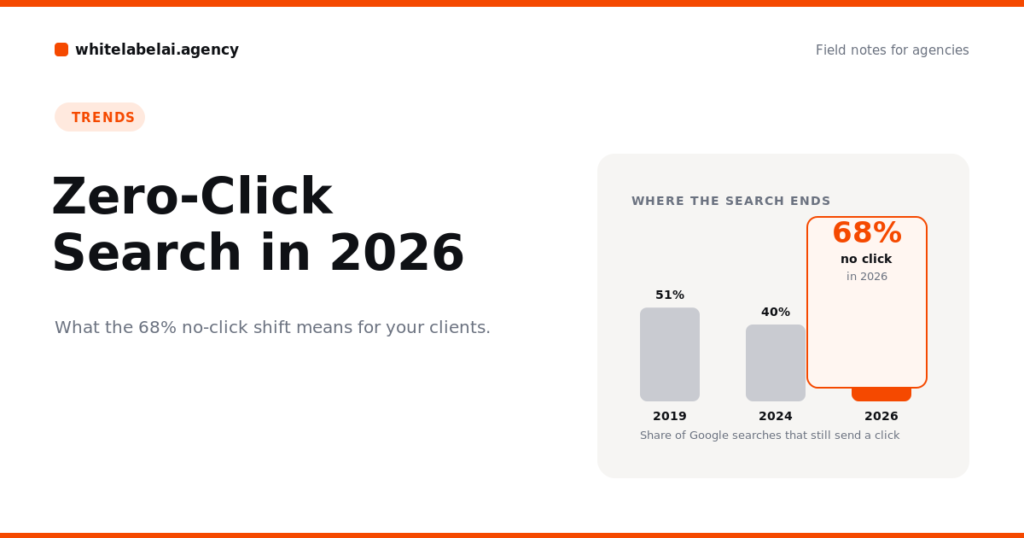
Yes. Zero-click search in 2026 means 68% of Google searches now end without a click, according to SparkToro‘s analysis of Similarweb clickstream data, up from 60.45% in 2024. For SEO agencies, that number makes traffic an unreliable KPI. The retainer has to shift toward AI visibility, citations, and revenue-linked outcomes.
What Zero-Click Search Actually Means in 2026
A zero-click search is exactly what it sounds like: someone searches, gets an answer directly in the results page, and never visits a website. In 2026, that’s the majority outcome of a Google search. It’s not an edge case anymore.
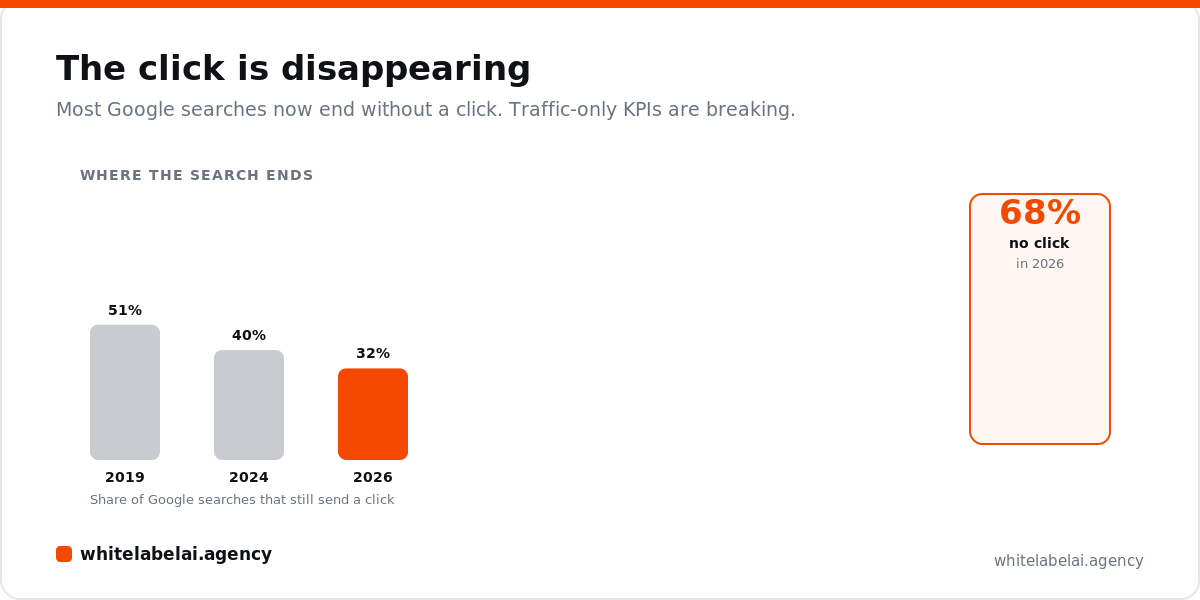
The data is unambiguous. In the first four months of 2026, 68.01% of U.S. Google searches ended without a click, according to SparkToro’s Rand Fishkin, working from Similarweb’s desktop and mobile clickstream panel. Two years earlier, that figure was 60.45%. That’s a 7.56-point jump, or roughly 12.5% growth, in the shortest span SparkToro has ever recorded for this trend. Go back further and the picture gets starker: about 49% of Google searches were zero-click in 2019. We’ve moved from “half the time” to “two out of three times” in under a decade.
AI Overviews are the accelerant, not the whole story. Google’s AI-generated summaries now appear on roughly 20.5% of all search queries, according to a 146-million-SERP analysis from Ahrefs. When an AI Overview shows up, click-through rate on the organic results below it drops by nearly 58%, according to Ahrefs‘ updated analysis. Pew Research Center found something similar in its own panel study: searchers clicked a traditional organic result in just 8% of searches that displayed an AI summary, versus 15% when no summary appeared.
Scale matters here too. Google CEO Sundar Pichai told the Google I/O 2026 keynote that AI Overviews now reach more than 2.5 billion monthly users. AI Mode, the more conversational search experience, has already crossed 1 billion monthly users, with query volume more than doubling every quarter. Neither of those products is slowing down. Both were built to keep the answer on Google’s page, not send the user to yours.
Why Traffic-Only KPIs Are Breaking
Here’s what’s happening inside a lot of client accounts right now: rankings are stable, content is strong, technical SEO is clean, and traffic is still falling. That’s not an execution failure. It’s a distribution shift, and we’ve written before about how it changes what SEO actually is for agencies selling it as a standalone service.
A client can rank #1 for their target keyword and lose the click to an AI Overview sitting above it. When that happens every month, the monthly ranking report starts to feel like a lie, even though nothing on it is technically false. The account manager who keeps presenting “position #2, up from #4” without addressing the traffic decline underneath it is the account manager who loses the renewal conversation.
There’s a second complication most agencies haven’t priced in yet: AI visibility isn’t one thing. A 2026 analysis of 680 million AI citations by Averi, corroborated by a separate 118,000-response study from Whitehat SEO, found that only 11% of domains get cited by both ChatGPT and Perplexity. Ranking well in Google’s AI Overview says almost nothing about whether a brand shows up in ChatGPT. These are genuinely separate visibility surfaces, each with its own citation logic, and tracking them is now its own discipline. We built a full breakdown of how to measure it, because most agencies are still flying blind on this.
What Changes for Your Client Reporting
The fastest way to lose a client in 2026 is to keep reporting the same five metrics you reported in 2022 and hope nobody asks why traffic and rankings have stopped moving together. Here’s the shift we recommend making in every client QBR:
| Old KPI (breaking) | Why it’s breaking | Report this instead |
|---|---|---|
| Organic sessions / traffic | 68% of searches never click through, so a ranking win doesn’t guarantee a visit | AI citation share: how often the brand is the cited source across ChatGPT, Perplexity, and Google AI Overviews for target queries |
| Keyword position (1–10) | Position no longer predicts a click; AI Overviews sit above position 1 on roughly 1 in 5 searches | Answer inclusion rate: the percentage of tracked queries where the client’s content is the one AI systems pull from |
| Click-through rate | CTR falls by up to ~60% once an AI Overview appears on a query, per Ahrefs | Branded search volume: direct and branded query growth, a proxy for AI-driven recall even without a click |
| Backlinks acquired | Still useful for authority signals, rarely the client’s actual business goal | Assisted conversions: pipeline, calls, and demos attributable to content, tracked through CRM source data |
| Content volume published | More posts don’t buy more visibility once the distribution layer is disintermediated | Share of voice against named competitors across AI answer engines |
| Domain Authority / DR score | A vanity number that says nothing about whether AI systems cite the brand | Revenue or pipeline influenced: the outcome the client is actually paying the retainer for |
None of this means traffic disappears from the report. It means traffic moves down the page, and AI visibility and revenue influence move up.
The Pivot Playbook: Repositioning the Retainer in 5 Steps
Reframing an SEO retainer isn’t a rebrand exercise. It’s a scope and pricing conversation, done deliberately, before the client forces it on you at renewal.
- Audit AI visibility before you touch the KPI deck. Run the client’s brand and their top 15–20 queries through ChatGPT, Perplexity, and Google AI Overviews. Document where they’re cited, where they’re missing, and who’s winning the citation instead. This is the diagnostic that makes the rest of the conversation credible.
- Add AI visibility as a distinct line item. Don’t fold it into the existing SEO scope for free. It’s genuinely new work, built on different signals, and it deserves its own price on the invoice.
- Restructure content for extraction, not just ranking. Answer-first paragraphs, FAQ schema, clear entity definitions. This is the AEO layer of the work, and it’s the part most agencies still skip because it doesn’t show up in a traditional rank tracker.
- Build the citation and mention layer. GEO is the practice of earning and growing presence inside generated answers, not just search results: Wikipedia entries, Reddit threads, review platforms, and the third-party sources AI models actually cite. It’s slower work than a blog post, and it compounds differently.
- Reset the client conversation before the next QBR does it for you. Show them the 68% number. Show them their own AI citation gap. Reframe the goal from “more clicks” to “more revenue, however it arrives.” Clients don’t actually want traffic. They want demand. Traffic was always just how you used to prove you were generating it.
Where Traditional SEO Still Wins
This isn’t a case for abandoning SEO fundamentals. Even SparkToro, the source of the 68% figure, is explicit that certain categories still convert clicks reliably: branded searches, local business queries, and high-intent transactional terms. If a client sells something people search for by name, or something people need from a business near them, SEO still earns visits the old-fashioned way.
Technical SEO also hasn’t become optional. Crawlability, indexation, and structured data are now the floor that AI systems stand on to find and cite content in the first place. Skip the technical layer and there’s nothing for an AI Overview to extract, no matter how good the AEO and GEO work on top of it is. The foundation still matters. It’s just no longer the whole pitch.
AEO and GEO: The New Product Agencies Sell
Answer Engine Optimization (AEO) and Generative Engine Optimization (GEO) aren’t rebrands of SEO. They’re distinct disciplines that solve for different outcomes.
AEO is about being selected as the answer inside a single search result: Google’s AI Overview, a featured snippet, a voice assistant response. It’s won through structure: direct-answer paragraphs, FAQ schema, and content organized around the exact question a user typed.
GEO is about being cited inside a generated answer that pulls from many sources at once: a ChatGPT response, a Perplexity summary, a Gemini answer. It’s won through entity consistency and third-party presence across the sources these models actually trust, which explains why only 11% of domains show up in both ChatGPT and Perplexity citations. Winning one doesn’t win the other.
Together, AEO and GEO fill the gap traffic-only reporting leaves behind. They’re measurable and sellable as a distinct service line, which makes them a stronger anchor for the 2026 pitch than last year’s traffic chart.
The Bottom Line for Agency Owners
I don’t think zero-click search is a crisis. I think it’s a repricing opportunity that most agencies are too slow to take.
Every client with a flat traffic chart and stable rankings is a client having a confusing, uncomfortable conversation with their own leadership right now, and they don’t have good language for what’s happening. The agency that shows up with the 68% data, an AI citation audit, and a clear plan to reposition the retainer around AI visibility isn’t the agency delivering bad news. It’s the agency solving the problem the client didn’t know how to name.
That’s a stronger position than defending a ranking report nobody trusts anymore.
Frequently Asked Questions
What is zero-click search?
Zero-click search happens when a search engine answers a query directly on the results page, so the user never clicks through to a website. In 2026, 68% of Google searches end this way, according to SparkToro’s analysis of Similarweb clickstream data, driven largely by AI Overviews and other on-page answer features.
Why did zero-click searches jump to 68% in 2026?
The increase is driven mainly by AI Overviews, which now appear on roughly 20.5% of Google searches and cut click-through rate by nearly 60% when present, according to Ahrefs. Google’s AI Mode and its growing instant-answer features are compounding the trend, even though AI Mode itself still accounts for a small share of total search volume.
Does zero-click search mean SEO is dead?
No. SEO still matters for branded searches, local business queries, and high-intent transactional terms, and technical SEO remains the foundation AI systems rely on to find and cite content. What’s changed is that SEO alone no longer reliably delivers traffic, so it can’t be sold or reported on as a standalone product anymore.
What should SEO agencies report to clients instead of traffic?
Report AI citation share, answer inclusion rate across ChatGPT and Google AI Overviews, branded search volume, and revenue or pipeline influenced by content. These metrics reflect how visibility actually works now, when two-thirds of searches never produce a click to measure.
What’s the difference between AEO and GEO?
AEO (Answer Engine Optimization) focuses on being selected as the direct answer within a single search result, like a Google AI Overview or featured snippet. GEO (Generative Engine Optimization) focuses on being cited inside a generated answer that draws from multiple sources, like a ChatGPT or Perplexity response. They require different tactics and should be tracked separately.
How do I measure AI visibility for a client?
Track how often a brand and its content are cited across ChatGPT, Perplexity, and Google AI Overviews for a defined set of target queries, then benchmark that citation rate against named competitors. This becomes a recurring, reportable metric the same way rank tracking used to be.
Will zero-click search keep increasing?
Most available evidence points that direction. SparkToro notes that Google’s ad revenue and AI investment both benefit from keeping searchers on-platform, and AI Mode’s usage is reportedly doubling every quarter as of the 2026 Google I/O keynote, which suggests more zero-click behavior ahead rather than less.
Should agencies drop SEO services entirely?
No. Agencies should stop selling SEO as a standalone deliverable and start selling it as one layer inside a broader AI visibility system that includes AEO and GEO. Clients still need the technical and content foundation SEO provides. They just need agencies to report and price the work differently.
Get the Data Before Your Next QBR
Every week, we send agency owners the AI visibility data, pricing shifts, and repositioning tactics we’re seeing across our partner network, straight from the blog. No fluff, no recycled stats.
If you want help auditing a client’s AI citation gap or restructuring a retainer around AEO and GEO, that’s a conversation worth having before the next renewal, not after.