
Answer engine optimization for agencies means restructuring client content so AI systems select it as the direct answer, not just one source among several. AEO is about being chosen as the answer: a direct answer box, a voice reply, a single confident response. GEO is about being cited inside a synthesized, multi-source answer. Agencies need both, built from the same content.
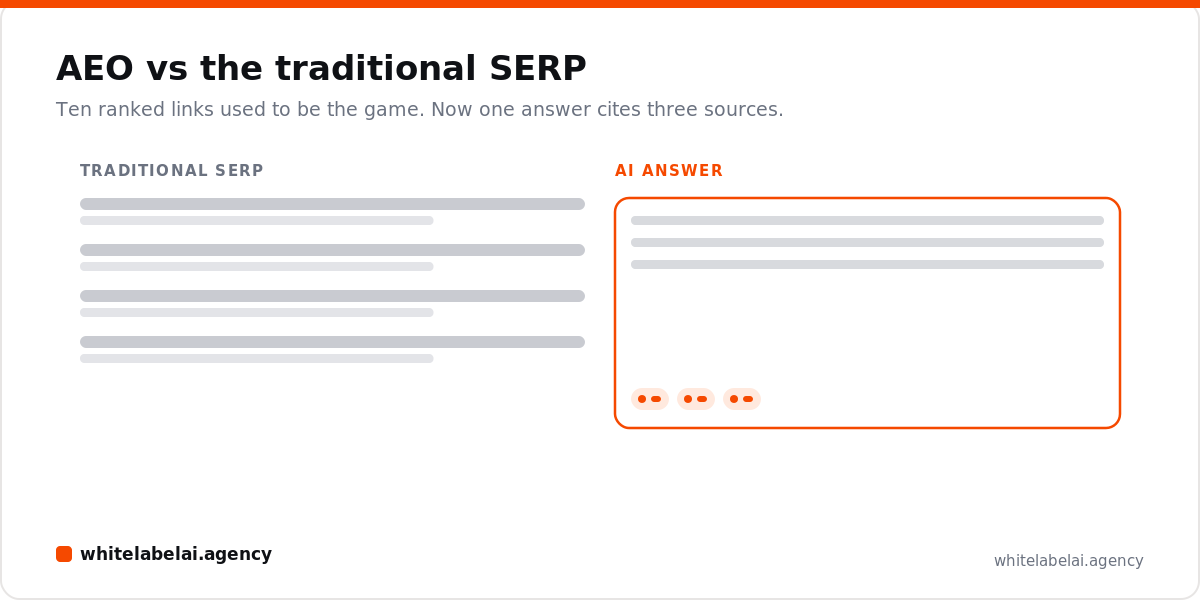
AEO vs GEO: two different wins from the same content
AEO and GEO get treated as synonyms in most agency pitch decks. They’re not. AEO gets your content selected as the answer. GEO gets your content cited alongside other sources inside a generated answer. The content requirements overlap heavily; the win condition doesn’t.
Ask Gemini “what’s the best CRM for a 10-person agency” and get one direct answer naming one source: that’s AEO. Ask Perplexity the same question and get a paragraph synthesizing eight sources, with your client named as one of three options: that’s GEO. Both are wins. Neither is the other.
That distinction changes what you sell and how you report on it. An AEO win is binary: selected or not. A GEO win is about share of voice across the citations you earn. We covered the citation-earning mechanics in our post on GEO for agencies, including a six-step framework for winning citations across ChatGPT, Perplexity, and Google AI Overviews. This post goes narrower: getting content structured well enough to get picked as the single answer. For the foundational case behind AEO as its own discipline, our earlier piece on AEO vs traditional SEO is the right starting point.
Why AEO can’t wait: the zero-click reality
Google searches ended without a click 68.01% of the time in the U.S. during the first four months of 2026, according to SparkToro research based on Similarweb clickstream data, reported by Search Engine Land in June 2026. That’s up from 60.45% in 2024, a 7.56-point jump in two years.
Clients aren’t losing traffic because their content got worse. They’re losing it because the result increasingly answers the question before anyone reaches the website. Content that isn’t structured to be the thing that gets read and quoted doesn’t lose a few points of clicks. It gets skipped entirely.
That’s the case for selling AEO as an ongoing service, not a one-time fix. A page ranking position one in Google’s blue links can still lose the moment that matters, the AI Overview or the chatbot’s direct answer, if it isn’t written to be extracted.
The answer-first content structure
Content built for AEO answers the question in the first sentence, then supports it with detail. Most SEO-era content buries the answer three paragraphs deep, after scene-setting, because that used to help dwell time. It’s now the biggest reason content gets skipped by answer engines.
Three parts make the structure work. A direct answer block right after the H1: 40 to 60 words, one declarative statement that answers the page’s core question and could be lifted out of context and still make sense. Every H2 opens with a one or two sentence answer before it expands. And entity clarity: name what the page is about in plain terms early, rather than leaning on pronouns a human reader follows but a model has to work harder to resolve.
In practice: a client’s page for “how much does a CRM implementation cost” shouldn’t open with three paragraphs on why choosing the right CRM matters. It should open close to: “CRM implementation for a 10-to-50-person business typically costs $8,000 to $25,000, depending on data migration complexity and integration count.” That sentence is the job. Everything after is context.
FAQPage schema: still the highest-impact structured data, with one caveat
FAQPage JSON-LD is the single highest-impact structured data type for getting content extracted by AI answer engines in 2026, though a 2026 Ahrefs study found JSON-LD produced no measurable citation lift, so treat it as a clarity aid, not a ranking lever. The structure: a FAQPage type containing a mainEntity array of Question objects, each with a name field and an acceptedAnswer field holding the answer text. It hands AI systems a pre-parsed question-and-answer pair instead of prose they have to interpret themselves.
The caveat most agencies haven’t caught up on: Google stopped showing FAQ rich results in Google Search as of May 7, 2026. The expandable FAQ dropdown under a client’s listing is gone, and Search Console’s FAQ reporting is being phased out. Google says it will keep using FAQ structured data to understand pages even without displaying the rich result. So: FAQPage schema no longer buys SERP real estate in blue links, but it’s still one of the clearest signals you can give ChatGPT, Perplexity, Gemini, and AI Overviews about what a page answers. Keep it, just stop selling it as a rich-snippet tactic. Our companion post on schema markup for AI search breaks down which other schema types matter most across engines.
Keep FAQ answers to two to five sentences: long enough to be complete, short enough that a model can lift the first sentence and have it stand alone.
How ChatGPT, Perplexity, and Gemini actually differ
Treating “AI search” as one target is the most common mistake we see. The three major engines pull from different indexes and reward different content.
ChatGPT. Web-enabled ChatGPT search runs on Bing’s index for real-time retrieval, not Google’s. A site thin in Bing (most agencies have never checked Bing Webmaster Tools) is effectively invisible to it, regardless of Google rankings. Profound’s citation analysis shows ChatGPT leans heavily on high-authority, encyclopedic sources; Wikipedia alone takes the largest single share of its citations.
Perplexity. Perplexity leans hard on community content. Reddit alone accounts for nearly half the citations among Perplexity’s top-cited sources, per Profound’s data, well ahead of anything else. It’s the engine people turn to for opinion-seeking questions (“has anyone actually used X”), which polished brand content answers poorly. A genuinely useful presence in relevant subreddits does more for Perplexity citations than another blog post.
Gemini and Google AI Overviews. These run on Google’s index and Knowledge Graph, and for local queries lean heavily on Google Business Profile data. A complete GBP matched to consistent schema (LocalBusiness, Service, Review) correlates strongly with being cited. For local clients, profile completeness does as much work as the content itself.
Domain overlap between engines is also low, one more reason to plan for all three separately. Averi’s analysis of 680 million AI citations and a separate Qwairy audit of 118,000 AI responses (via Whitehat SEO) both found only around 11% of cited domains appear across both ChatGPT and Perplexity.
| Engine | Indexes from | What earns the direct answer | AEO priority |
|---|---|---|---|
| ChatGPT (web search) | Bing’s live index | Authoritative, definitional, well-entitied content | Bing indexing + clear “what is X” definitions |
| Perplexity | Live crawl + own index, forum-heavy | Depth, freshness, community validation | Reddit/forum presence, recent updates |
| Gemini / AI Overviews | Google’s index + Knowledge Graph + GBP | Schema completeness, top-10 ranking, profile data | FAQPage/LocalBusiness schema, GBP completeness |
The AEO framework agencies can sell as a service
This is the sequence for standing up AEO as a service line, for an agency’s own site or a client’s. It runs in about three weeks once the content foundation exists.
Step 1: Question audit (days 1–4). Map the real questions buyers ask, using AlsoAsked, People Also Ask, and a pass through relevant subreddits and support tickets. This replaces keyword research as the starting point.
Step 2: Answer-first rewrite (days 5–11). Retrofit the highest-value pages with a direct answer block under the H1 and answer-first openings under every H2. Prioritize pages that already rank reasonably well.
Step 3: FAQPage schema deployment (days 12–14). Add or upgrade FAQ schema on pages with a genuine FAQ section, following the two-to-five-sentence rule. Skip pages where the FAQ would be padding.
Step 4: Entity clarity pass (days 15–17). Tighten Organization schema, confirm consistent naming sitewide, and state plainly what each page is about in the first 100 words.
Step 5: Platform-specific tuning (days 18–20). Confirm Bing indexing for ChatGPT, complete every Google Business Profile field for Gemini, and identify community spaces worth a genuine presence for Perplexity.
Step 6: Manual query testing, ongoing. Run 15 to 25 buyer questions against ChatGPT, Perplexity, and Gemini monthly, and log whether the client is the direct answer, a citation, or absent. There’s no Search Console equivalent yet.
Agencies package this as a standalone AEO sprint or an add-on to an SEO retainer. If you’re running the AI SEO upsell motion we describe in selling AI SEO services to clients, this framework slots in as the AEO line item inside that offer. SEO agencies weighing how AEO/GEO fits their delivery model can see how we structure that partnership on our SEO agency page.
Traditional SEO vs AEO: what actually changes
| Dimension | Traditional SEO | AEO |
|---|---|---|
| Primary goal | Rank in the top 10 organic results | Get selected as the direct answer |
| Success signal | Position, impressions, clicks | Answer-selection rate across a fixed query list |
| Content unit | Long-form pages built around a keyword | Self-contained, quotable answer blocks |
| Where it lives | Google Search Console | Manual or tool-assisted query testing |
| Refresh cycle | Periodic updates | Frequent; stale answers get replaced fast on Perplexity |
| Core technical lever | Backlinks, domain authority, site speed | Schema, entity clarity, Bing indexing |
| What “winning” looks like | Blue link at position one | Your sentence, verbatim, inside the AI’s response |
| Biggest failure mode | Thin content that never ranks | Buried answers that rank but never get extracted |
These aren’t competing for budget so much as solving different halves of the same problem. A page with no SEO foundation rarely earns AEO visibility, since most engines still lean on some baseline ranking signal. A well-ranking page written the old way, answer buried in paragraph four, keeps losing the AEO layer even while it holds its Google position.
What’s proven and what isn’t
Being straight about this discipline’s limits matters more than sounding confident about all of it.
What’s solid: the correlation between answer-first structure, FAQPage schema, and higher extraction rates shows up consistently across independent studies from multiple research firms. The zero-click trend is well-measured and directionally unambiguous. The platform differences above are confirmed by the platforms’ own architecture, not just correlation.
What’s not proven: nobody outside OpenAI, Google, and Perplexity knows the exact weighting of any ranking or extraction signal, and none of those companies publish one. There’s no Search Console equivalent for AI answer selection, so every measurement approach right now, including the manual query testing above, is a proxy, not a ground-truth metric. Citation behavior is also volatile week to week on some engines, particularly Perplexity. Our post on AI search visibility tracking goes deeper on building a defensible measurement process. Any agency pitching AEO with guaranteed placement language is overselling a discipline still being reverse-engineered in public.
Frequently Asked Questions
What’s the difference between AEO and GEO?
AEO gets content selected as the single direct answer, the kind of result a voice assistant reads aloud or a chatbot returns without hedging. GEO earns a citation inside a synthesized answer drawing on multiple sources. AEO wins are binary; GEO wins are about share of citations. Most content work supports both at once.
Is AEO different from traditional SEO?
Yes. Traditional SEO optimizes for ranking in search results. AEO optimizes for being extracted and selected as the answer, which requires different structure even when the page targets the same keyword. Strong SEO is usually a prerequisite for AEO, not a replacement.
Does FAQPage schema still matter if Google removed FAQ rich results?
Yes, for AI engines specifically. Google stopped displaying FAQ rich results in Google Search as of May 7, 2026, so FAQ schema no longer produces the dropdown in blue-link results. It remains one of the clearest structured-data signals for ChatGPT, Perplexity, Gemini, and AI Overviews to extract question-and-answer content directly.
How do I get cited by ChatGPT?
Start with Bing. ChatGPT’s web search runs on Bing’s index, so weak Bing presence makes a site largely invisible to it regardless of Google rankings. From there, write definitional, entity-clear content; ChatGPT’s citation data leans heavily toward authoritative sources like Wikipedia.
Which AI engine should agencies prioritize for a client?
It depends on audience and category. B2B SaaS clients tend to see the most qualified activity from ChatGPT. Research-heavy or opinion-driven categories often do better on Perplexity. Local and service businesses should prioritize Gemini and AI Overviews, where Google Business Profile completeness carries real weight.
How long does AEO take to show results?
Early wins on well-structured content can appear within a few weeks. Durable presence across multiple engines typically takes a few months, similar to GEO citation timelines. Perplexity shifts fastest given how aggressively it favors fresh content; Gemini and AI Overviews move more slowly.
Can agencies sell AEO without hiring AI specialists?
Yes, if the agency already has solid content and technical SEO capability. AEO mostly extends that skill set plus a new measurement layer. Agencies without that foundation often partner with a white-label AI delivery partner to stand up the service faster.
How do you measure whether AEO is working?
Run 15 to 25 real buyer questions against ChatGPT, Perplexity, and Gemini monthly, and log whether the client is returned as the direct answer, a citation, or absent. There’s no official dashboard for this yet, so tracking is manual or tool-assisted. Watch the trend across months, not a single snapshot.
Add AEO to your agency’s service line
Most agencies pitching AI search visibility right now are selling a slide deck, not a working service. The gap between “we do AEO” and an agency that can show a client their answer-selection rate moving month over month is where the renewals happen.
If you’d rather not spend the next two quarters building this capability from scratch, white-label delivery gets the entity work, schema deployment, answer-first rewrites, and monthly query tracking running under your brand, with your first client engagement live inside 30 days.
We’ll walk through the AEO framework end-to-end and what it looks like packaged inside your existing service menu. No slide deck, no sales pressure. Just a working session.