
Yes. Agencies can sell white label AI voice agents as a recurring service line by partnering with a provider that runs the voice infrastructure while the agency owns the client relationship, pricing, and brand. Clients see a branded AI receptionist that books appointments and qualifies leads; the partner runs the model, telephony, and compliance behind it.
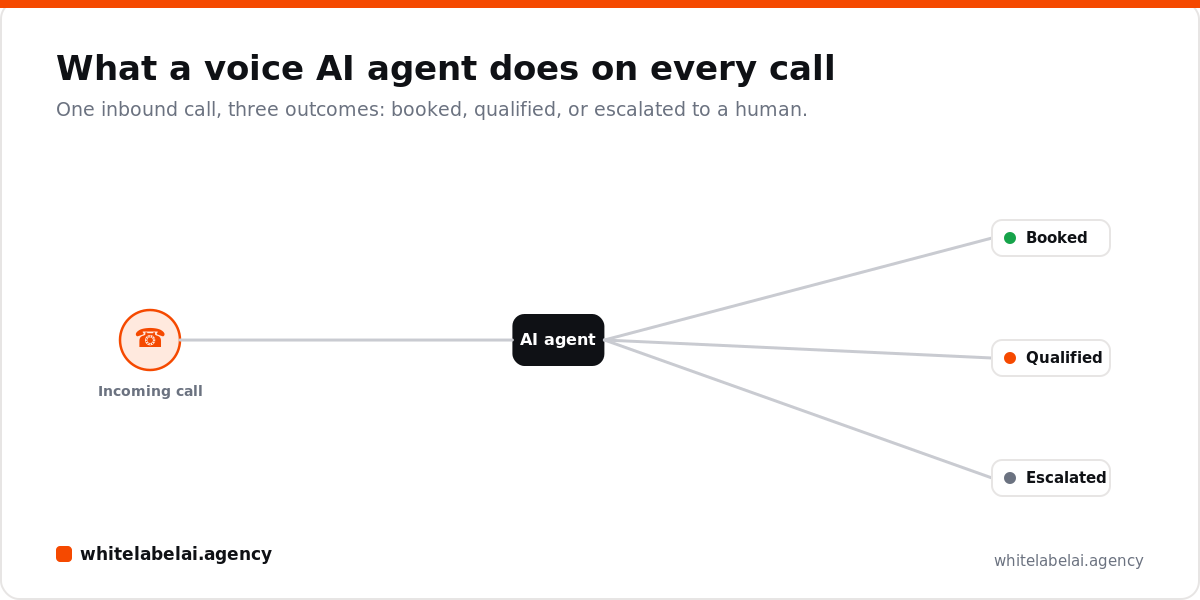
What “white-label AI voice agents” means for an agency service line
A white-label AI voice agent is a phone-based AI system that answers, makes, or routes calls under your agency’s brand, while a technical partner builds and hosts the model behind it. The client never sees the vendor name. They see a phone number that answers with their business name, a dashboard with your agency’s logo, and a monthly report from you.
Grand View Research projects the global AI voice agents market at $3.51 billion in 2026, on a path toward $35.2 billion by 2033 at a 39.0% CAGR, per Grand View Research’s June 2026 update. Agencies that already own the client relationship are positioned to capture a slice of that before it commoditizes.
This is the same split that already works for AI SDR as a service: the agency owns strategy and the relationship, the partner owns delivery. Voice is the highest-friction channel to build in-house, since it touches telephony, real-time speech models, and call compliance at once.
| What the client sees | What the white-label partner runs |
|---|---|
| A branded phone number and AI receptionist answering with the business’s name | The voice model, speech-to-text/text-to-speech stack, and LLM orchestration |
| A dashboard (your logo, your domain) showing calls, bookings, transcripts | Prompt design, call flow logic, and ongoing tuning |
| A monthly performance report from their account manager | Telephony, uptime, and failover across providers |
| Their own agent name on the call: “Hi, this is Aria from [Client Business]” | Compliance work: TCPA consent, recording disclosure, data retention |
The relationship and the invoice stay with you. Everything technical sits with the partner.
The four voice AI services agencies package and sell
Most white-label voice AI offers reduce to four use cases, each with a distinct buyer and pricing logic.
Appointment booking. The AI answers inbound calls, checks the client’s calendar, and books the slot without human involvement. A missed call in home services or dental can cost $200 to $500 in lost revenue per instance, which makes the ROI case easy.
Lead qualification. Inbound calls get scored against a script before routing to a rep or the CRM. Outbound versions call new leads within minutes of form submission, when conversion odds are highest.
Reception and after-hours coverage. The AI covers a front desk during business hours, lunch breaks, nights, and weekends, closer to a traditional answering service but with booking and FAQ-handling built in.
Call triage. Inbound calls get classified and routed: billing to one queue, emergencies to an on-call line, sales to a rep, everything else to a callback list. This overlaps with what agencies already sell as AI customer support for clients; voice triage is the phone-channel version of the same escalation logic.
Which platforms actually power white-label voice AI in 2026
Five platforms come up constantly in agency research. Here’s what each verifiably offers as of mid-2026.
Synthflow dropped its fixed agency tiers in 2026. It now runs pay-as-you-go usage (roughly $0.12/minute effective) plus a separate White-Label and Reseller Toolkit add-on priced around $2,000/month for custom domains, branding, and sub-accounts. It includes a no-code flow builder and SOC 2, HIPAA, and GDPR coverage.
Stammer.ai charges $197/month for its Agency plan (unlimited sub-accounts, 20+ voice agents included, extra agents $5/month each), with usage at $0.11 to $0.17/minute depending on the LLM. It combines chat and voice under one dashboard but publishes GDPR compliance only, which rules it out for healthcare and financial clients.
Insighto.ai runs pay-as-you-go with no required subscription: voice around $0.06/minute, chat at $0.015/query, with paid tiers at $49, $149, and $249/month (plus Agency Starter at $299/month and Agency Pro at $499/month). It has a dedicated agency page with custom domains and branded dashboards, and it’s the budget entry point among agency-ready platforms.
Retell AI and Vapi are a different category: developer-first infrastructure. Retell’s base rate is $0.07/minute and Vapi’s is $0.05/minute, but neither is the real cost once speech-to-text, an LLM, text-to-speech, and telephony are added; actual per-minute costs typically land between $0.13 and $0.33 on both. Neither ships a built-in reseller portal; agencies white-label them via a custom front end or a third-party wrapper (Vapify, Voicerr, VoiceAIWrapper), which adds a second vendor and invoice.
The practical split: Synthflow, Stammer.ai, and Insighto.ai are built for agencies to resell out of the box. Retell and Vapi are built for developers and need engineering time or a wrapper layer.
Pricing and margin: starter, growth, and premium tiers
Agencies package voice AI in roughly three tiers, reflecting what’s actually charged across white-label voice AI resale programs in 2026.
| Tier | What’s included | Client price/mo | Wholesale delivery cost | Agency gross margin |
|---|---|---|---|---|
| Starter | Inbound reception, 1 number, basic FAQ and booking | $250–$400 | $50–$120 | 65–80% |
| Growth | Full booking and lead qualification, CRM integration, call analytics | $400–$800 | $100–$250 | 65–80% |
| Premium | Inbound and outbound campaigns, multi-location, dedicated support | $800–$1,500+ | $200–$450 | 65–80% |
The pattern holds because platform cost is mostly fixed while usage cost scales slowly relative to price, a different margin profile than labor-based services. Our guide to pricing AI services for agencies covers the setup-fee-plus-retainer structure that layers on top: a $1,000 to $2,500 onboarding fee for call flow design and integration, then the monthly retainer above. High-ticket verticals increasingly price outbound “AI closer” programs at $500 to $2,000/month instead, since each converted lead is worth thousands.
Build vs. buy vs. white-label: the agency decision
Three paths exist for adding voice AI, and the tradeoffs mirror what agencies already face with AI SDR delivery.
| Build in-house | Buy and operate a platform directly | White-label delivery | |
|---|---|---|---|
| Time to first client live | 4–8 months | 6–10 weeks | 2–4 weeks |
| Upfront investment | $50K–$150K | $2K–$5K | $0–$1K |
| Infrastructure risk owner | You | You, with vendor support | Partner |
| Compliance burden | Entirely yours | Mostly yours | Shared with partner |
| Ceiling on client volume | Engineering headcount | Your ops time per client | Scales with client count |
| Risk if the model underperforms | Sunk engineering cost | Locked into platform contract | Switch partners |
Building in-house makes sense only if voice AI is your core product, not an added line. For most agencies adding this as a fourth or fifth service line, white-label delivery is the lower-risk path: the partner owns the infrastructure and the 2am outage call, you own the client relationship and the margin.
Where voice AI still fails, and how to set client expectations
Voice AI in 2026 is good enough to sell. It is not good enough to promise perfection, and agencies that oversell it lose clients in month two.
Accents and dialects. Speech-to-text trained mostly on standard American or British English still misfires on regional accents, non-native speakers, and specialized vocabulary.
Interruptions. When a caller talks over the AI mid-sentence, weaker systems plow through, garble both streams, or go silent. Good barge-in handling separates a natural call from something that feels like leaving a voicemail.
Background noise. Cars, cafes, and job sites degrade recognition, and home services and field-service verticals hit this constantly.
Confident wrong answers. An agent stating the wrong price or hours with full confidence is worse than one that says “let me check and call you back.” Test for this in a pilot before full rollout, not after an angry client finds it.
Anything emotional or ambiguous. Complaints, medical symptoms, legal questions: route to a human immediately, with a clearly defined handoff built into every deployment.
There’s a compliance layer to build into the pitch, not bolt on later. AI-generated voices are classified as “artificial or prerecorded” under the TCPA, carrying robocall-level consent requirements, and the FCC has ruled AI-generated voices in unsolicited robocalls illegal. California’s SB 1001 has required bot disclosure since 2019, and Texas’s SB 140 requires AI voice disclosure within the first 30 seconds of a call. For EU clients, the EU AI Act adds self-identification, scope guardrails, and an opt-out path. We build these into the call script from day one; retrofitting compliance after launch is a much harder conversation.
Set the expectation up front: this handles the predictable 70 to 80% of call volume. It is not a replacement for a skilled human on complex or high-stakes calls, and a good AI voice agent should say so out loud.
Which verticals actually buy AI voice agents
Four verticals account for most of the demand agencies are converting into deals right now.
Home services (HVAC, plumbing, electrical, roofing) buy for after-hours coverage and speed-to-lead. A missed call at 9pm on a burst pipe is a lost customer to whoever answers first.
Clinics and dental practices buy for appointment booking and no-show reduction, where a single missed appointment commonly represents $200 to $500 in lost chair-time revenue.
Real estate buys for lead qualification and outbound follow-up on aging leads, a harder sell given longer sales cycles, but a sticky one once proven.
Legal buys for intake triage and after-hours coverage, particularly personal injury and family law, where a missed call after hours often means the caller phones a competitor next.
The winning first pitch is consistent across all four: show the prospect a call they recently missed, run a live demo call to their own number, and quantify that miss in their own numbers. The AI use cases for agencies breakdown covers how this pitch structure applies beyond voice.
Frequently Asked Questions
What is a white label AI voice agent?
A white label AI voice agent is a phone-based AI system that answers, makes, or routes calls under an agency’s own brand, while a technical partner builds and hosts the underlying voice model, telephony, and compliance infrastructure. The end client only sees the agency’s branding, dashboard, and invoice.
How much can agencies charge for AI voice agent services?
Most agencies charge $250 to $1,500 per month depending on tier: entry-level reception around $250 to $400/month, premium multi-location or outbound programs at $800 to $1,500+/month. High-ticket verticals sometimes pay $500 to $2,000/month for outbound “AI closer” programs.
What margin do agencies make reselling white-label voice AI?
Gross margins typically run 65 to 85% once an agency clears its platform break-even point, usually 4 to 9 clients depending on the platform’s fixed monthly cost. Margin improves with client count because platform cost is largely fixed while usage cost scales slowly.
Which platforms let agencies white-label AI voice agents?
Synthflow, Stammer.ai, and Insighto.ai are built for agency reselling out of the box, with branded dashboards and sub-accounts included or available as an add-on. Retell AI and Vapi are developer-first infrastructure; agencies typically white-label them via a custom front end or a third-party wrapper platform.
Can AI voice agents handle emotional or complex calls?
No, not reliably. AI voice agents perform well on predictable, scriptable interactions: booking, qualification, FAQs, routing. Complaints, medical symptoms, and legal questions should route to a human immediately.
Do AI voice agents need to disclose that they’re AI?
In many cases, yes. AI-generated voices are classified as “artificial or prerecorded” under the TCPA in the US, and the FCC has ruled AI-generated voices in unsolicited robocalls illegal. California, Texas, and other states have their own disclosure requirements, and the EU AI Act requires self-identification. Build disclosure into the call script from day one.
Which industries buy white-label AI voice agents most?
Home services, clinics and dental practices, real estate, and legal are the four verticals generating the most agency deals in 2026. Home services and dental buy primarily for missed-call recovery and booking; real estate and legal buy more for lead qualification and after-hours intake.
Should an agency build its own voice AI or use a white-label partner?
For most agencies adding voice AI as a new service line, white-label delivery is faster and lower-risk than building in-house. Building requires $50K to $150K upfront and 4 to 8 months before a client can go live; white-label delivery gets a first client live in 2 to 4 weeks, with the partner carrying infrastructure and uptime risk.
Ready to add voice AI to your service line?
Your clients are already losing revenue to missed calls. Home services, clinics, real estate, and legal firms in your book of business are prime candidates for a white-label AI voice agent, and the margin math works from the first handful of clients.
If building this in-house isn’t the best use of your team’s time, white-label delivery gets your first client live in weeks, with your brand on every call.
We’re booking Q4 2026 partner slots across the US, UK, EU, and AU: one working session on how white-label voice AI delivery runs and how to pitch it to your existing clients.