
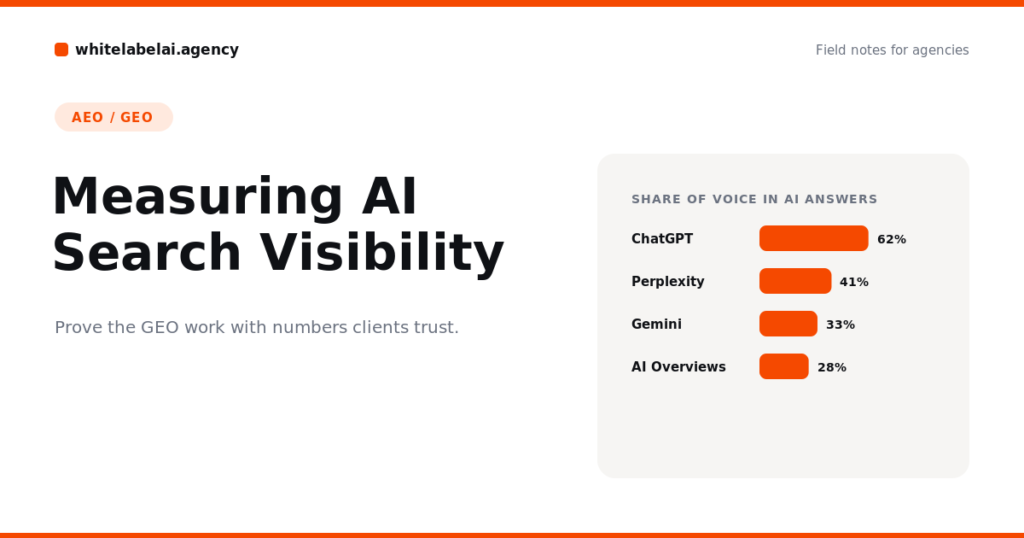
AI search visibility tracking is the practice of running a fixed set of prompts against ChatGPT, Perplexity, Google AI Overviews, and other AI engines on a schedule, then measuring how often, how prominently, and how favorably your brand gets cited. It replaces rank position as the proof point for GEO and AEO work.
Why Rank Position Stopped Being the Whole Story
Rank position still matters, but it no longer predicts whether an AI engine cites you. According to SparkToro’s June 2026 analysis of Similarweb clickstream data, 68.01% of Google searches in the US ended without a click in the first four months of 2026, up from 60.45% in 2024. A Pew Research Center study of real browsing data explains why: users clicked a traditional result in just 8% of searches when a Google AI Overview appeared, versus 15% when it didn’t. Clicking a source link inside the summary itself happened in just 1% of visits.
A client can hold position one and still be invisible in the answer that actually gets read. Ranking and citation are now two different outcomes, measured two different ways. We cover that shift in seo is not dead, but it’s no longer the product agencies sell, and geo for agencies lays out the expanded deliverable. Scale makes this urgent too: OpenAI reported ChatGPT crossed roughly 900 million weekly active users by mid-2026, a channel your clients are already being judged in.
The Metrics That Actually Measure AI Search Visibility
AI search visibility runs on four core metrics, and none of them map cleanly onto a keyword ranking.
| Metric | What it measures | Closest traditional SEO equivalent |
|---|---|---|
| Citation frequency | How often an AI engine cites your domain across a defined set of prompts | Keyword ranking position |
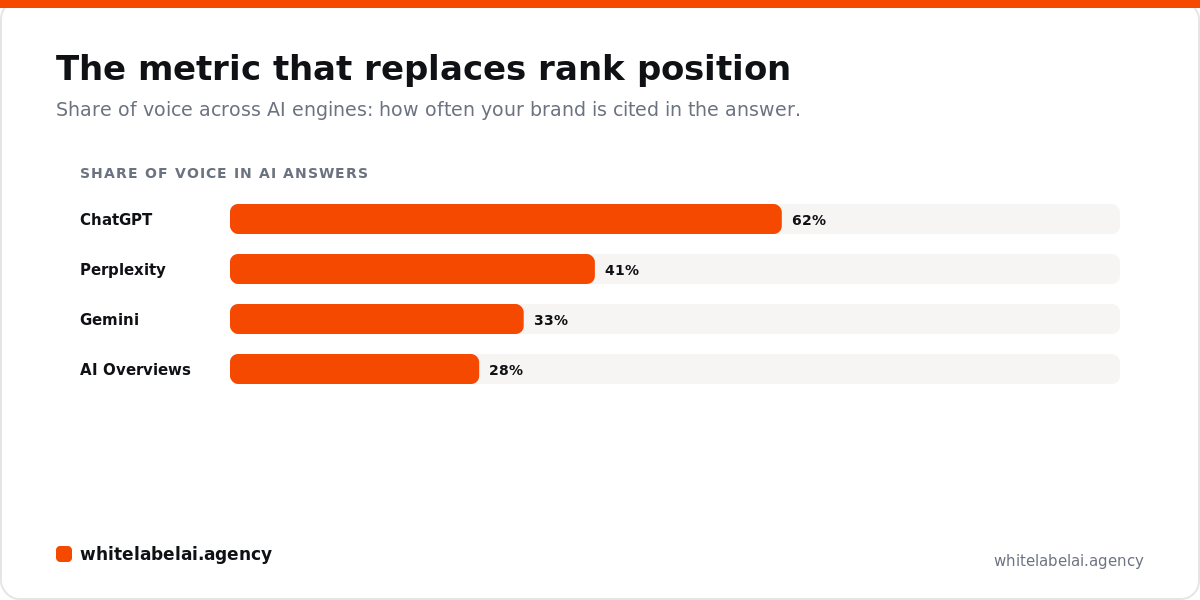
| Share of voice (mention share) | Your citations as a percentage of all brand citations returned for a topic | Share of page-one real estate vs. competitors |
| Sentiment | Whether the AI’s mention of your brand is positive, neutral, or negative | Brand sentiment in reviews and social listening |
| Prompt coverage | The percentage of a defined prompt set where you appear at all, regardless of position | Keyword coverage / share of search |
Citation frequency tells you if you’re showing up. Share of voice tells you if you’re winning against the competitors an AI engine keeps naming instead of you: a brand can have strong citation frequency and still lose the account if a competitor’s share of voice on commercial-intent prompts is three times higher.
Prompt coverage is the metric most agencies skip, and usually the most useful one in a client conversation: if your client is cited on 40% of a 100-prompt set built from real buyer questions, that’s a concrete number to put next to last month’s. It overlaps most with aeo for agencies, since answer engine optimization work is largely aimed at widening that coverage.
How AI Search Visibility Tracking Actually Works
Tracking runs on repetition, not a one-time audit:
- Build a prompt set. 20 to 100+ real buyer-language questions, phrased the way a buyer types them: “best CRM for a 10-person agency,” not “CRM software.” Pull these from sales calls, support tickets, and existing keyword research.
- Run the prompts on a fixed schedule. Daily or weekly, against each target engine, typically ChatGPT, Perplexity, and Google AI Overviews first.
- Parse each response. Log which domains got cited, whether the client’s brand was named directly, what competitors appeared, and the sentiment of any mention.
- Aggregate into per-engine and blended scores. ChatGPT and Perplexity behave differently. A blended score without the per-engine breakdown hides where the real gap is.
- Track the trend, not the snapshot. AI responses are non-deterministic; the same prompt run twice can return different citations. A single day’s reading is noise, a four-week rolling average is signal.
This is mechanically simple. What makes it hard is volume: running 30 prompts by hand across three engines, weekly, isn’t sustainable past a handful of clients. That’s the gap the tools below exist to close.
AI Visibility Tools: What’s Available in 2026
Pricing in this category shifts monthly. Here’s what’s live, verified directly from each vendor’s pricing page.
| Category | Example tools | Rough pricing (verified direct from vendor, Jul 2026) |
|---|---|---|
| Enterprise / high-volume | Profound | $99/mo (ChatGPT only) to $399/mo (3 engines); custom Enterprise at $2,000–$5,000+/mo |
| Mid-market, agency-friendly | Otterly.ai | $29–$489/mo (15–400 prompts); Agency Partner status adds prompts and white-label workspaces |
| GEO analytics for agencies | Peec AI | ~$95–$420/mo brand plans; agency plans ~$245–$495/mo for a 2–5 client portfolio |
| Bolted onto rank tracking | Nightwatch | €79/mo Starter to €399/mo Agency (500 AI prompts + 7,500 keywords); unlimited seats |
| Bolted onto an SEO suite | SE Ranking | Add-on ~$89/mo atop a Core/Growth plan ($129+/mo), or standalone from ~$189/mo |
| AI visibility + content optimization | Frase | $39–$239/mo; AI-visibility tracking folded into every tier |
| Lean visibility + insights | Omnia | €79/mo (25 prompts) to €279/mo (adds sentiment); Enterprise from €499/mo |
Almost every tool tracks the same core engines: ChatGPT, Perplexity, Google AI Overviews, and increasingly Google AI Mode, with Claude, Gemini, and Copilot as included or paid add-ons. Daily tracking is standard even at entry-level tiers, and pricing scales on prompt volume, not feature count, so the real cost driver is how many prompts each client needs.
Packaging AI Visibility Tracking as a Monthly Client Deliverable
A usable deliverable has five parts: citation frequency trend, share of voice against named competitors, a sentiment summary, the prompt coverage gap list, and three to five content fixes tied to that gap. Skip the fixes and you’ve sold a dashboard, not a service, the top reason clients churn out of reporting-only retainers.
The honest pricing range is wider than most sales pages let on. Agency-tier tool plans run roughly $200–$500/month for a small roster (Peec’s Growth tier at $495/mo, Nightwatch’s Agency plan at €399/mo) up to $2,000–$5,000+/month for enterprise coverage at the Profound end. Most agencies don’t need the top of that range to start; $200–$400/month covers 3–5 clients comfortably.
The markup is where the margin lives. Soar Agency’s pricing research puts the typical resale line item at $200–$500 per client per month, bundled into an existing retainer. Even at $150–$200 per client, a $400/month tool plan is recouped by the third client, the same logic in selling ai seo services to clients. Disclose the split; clients who later find a $300 tool cost marked up to a $1,500 fee don’t renew.
Why This Discipline Is Still Young
Be straight with clients: there is no industry-standard way to calculate an “AI visibility score” yet. Different tools weight engines differently, build prompt sets differently, and sample non-deterministic AI responses at different frequencies, so the same brand can show a 34% citation rate in one tool and a 51% in another, and both can be technically correct. Analysis from getpassionfruit.com puts it plainly: without standardized inputs or outputs, GEO and AEO’s measurement layer hasn’t stabilized the way SEO’s rank-tracking category did.
The cross-engine data backs this up. An analysis of 680 million AI citations by Averi found that only about 11% of domains were cited by both ChatGPT and Perplexity for the same topics, a figure corroborated independently by a separate Whitehat SEO study of 118,000 AI responses. For most brands, the two most-used AI engines are looking at almost entirely different source sets. That’s not a tooling bug; it’s the strongest argument for tracking at least three engines rather than optimizing for whichever one is easiest.
Pick one tool, disclose its methodology, and track trend direction against your own baseline rather than presenting the score as an external benchmark. Consistency inside one measurement system beats chasing a “correct” number that doesn’t exist yet.
Common Mistakes Agencies Make When Selling AI Visibility Reporting
Treating one tool’s score as an industry standard. There is no DR- or DA-equivalent for AI visibility yet. A number presented without its methodology invites the client to compare it against a competitor’s tool and ask why they don’t match.
Tracking one engine and calling it “AI visibility.” Given the 11% citation overlap between ChatGPT and Perplexity, a ChatGPT-only report covers a slice of the picture, not the whole thing.
Delivering citation counts with no next step. “You were cited 34 times this month” without a recommended content change is a dashboard, not a service.
Marking up tool costs without disclosure. The margin is fine. Hiding it isn’t. Clients who later see the underlying tool’s public pricing feel misled, and that erodes trust faster than the report builds it.
Frequently Asked Questions
What is AI search visibility tracking?
Running a fixed set of prompts against AI engines like ChatGPT, Perplexity, and Google AI Overviews on a recurring schedule, then measuring citation frequency, share of voice, sentiment, and prompt coverage. It’s the measurement layer that proves whether GEO and AEO work is actually moving the needle.
How is AI visibility different from SEO rank tracking?
Rank tracking measures where a URL appears in a list of links. AI visibility measures whether an AI system selected your content as a source when generating an answer, which can happen at any rank position or fail even at position one.
How often should AI search visibility be tracked?
Daily tracking is standard because AI responses are non-deterministic and shift from run to run. For client reporting, a four-week rolling average is more reliable than any single day’s snapshot.
What counts as a “citation” in an AI answer?
Any instance where an AI engine names your brand, links to your domain, or paraphrases your site’s content inside its answer. Tools differ on whether an indirect mention with no link counts the same as a direct citation, one reason scores vary between platforms.
Can small agencies afford AI visibility tools?
Yes. Entry-level plans from Otterly.ai and Omnia start under $100/month, enough to track one or two flagship clients. Most agencies scale into a $200–$500/month agency-tier plan once they have three or more clients on the service.
Is there an industry-standard AI visibility score?
No. As of mid-2026, no standardized methodology exists across vendors. Different tools use different prompt sets, weight engines differently, and sample non-deterministic AI outputs at different frequencies, so agencies should disclose which tool and methodology produced a given number.
How much should agencies charge clients for AI visibility reporting?
A $200–$500 per client monthly line item is typical when bundled into an existing SEO or content retainer, enough to cover the underlying tool cost by the third or fourth client.
Turning AI Visibility Data Into a Sellable Service
Running the prompts is the easy part. Building the reporting cadence, the fix list, and the client-facing narrative is where most agencies stall, especially without a specialist on staff. That’s the gap a white-label build partner closes: we run the measurement layer and the optimization work behind your brand, so the deliverable reaches the client as your service, not ours.
Book a partner call → to see what an AI search visibility package looks like built for your agency’s client base.